

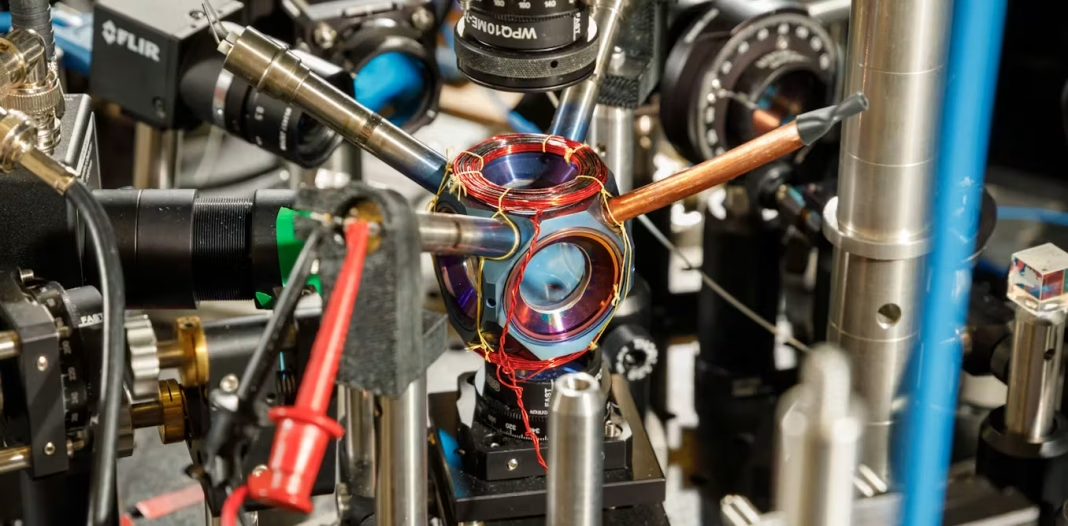

Quantum computers get a lot of attention, even though they are not ready for prime time, but quantum sensors are already doing useful work. These sensors measure fields, forces and motion so small that ordinary background noise can drown them out. Some sensors are already in daily use, while others are moving from research labs into flight tests, hospitals and field instruments.
For example, a human brain produces magnetic signals in the femtotesla-to-picotesla range – billions of times weaker than a refrigerator magnet – far weaker than the magnetic noise in an ordinary room. That is why brain scanners that measure these signals need ultrasensitive detectors and strong magnetic shielding. In some hospitals, these detectors use quantum technology to help map brain activity before epilepsy surgery, without touching the brain.
Quantum sensors are showing up in other fields as well, including in navigation when GPS signals are jammed or spoofed, mapping gravity to reveal what’s underground, and boosting astronomers’ ability to measure gravitational waves. I am a photonics and quantum technologies researcher. My lab applies physics to develop a range of devices, including quantum sensors.
What is a quantum sensor?
A sensor turns a physical effect – temperature, pressure, light, acceleration or magnetic field – into a number. Most sensors do this with engineered parts: springs, coils or computer chips. But these can drift, or become less accurate, as they age or warm up.
A quantum sensor uses a tiny quantum system as the “active ingredient” that interacts with the world to measure a physical quantity. The most common choices for quantum systems are atoms, electron spins, and superconducting circuits.
An atom has a fixed set of energy levels, like rungs on a ladder. Light or microwaves can move it between those levels only at exact frequencies. A magnetic field, motion or gravity can shift those frequencies or change the phase of the atom’s wave, and the sensor turns that shift into a measurement.
A spin is a built-in property of electrons that makes them act like an infinitesimal cross between a spinning top and a bar magnet. Using spins as a sensor means measuring how a magnetic field causes the spin to “wobble.” The spin is like a spinning top and the magnetic field is like your finger gently touching the top. How much the top wobbles in response indicates how forcefully you touched the top, an analogy to measuring the strength of the magnetic field.
Another type of quantum sensor is a superconducting circuit, an electrical circuit cooled to extremely low temperatures so current flows with no resistance. A superconducting quantum interference device, or SQUID, is a superconducting loop. This electrical loop is sensitive to tiny changes in magnetic fields, which register as measurable changes in an electrical signal from the device.
Most quantum sensors follow a three-step loop: They prepare a known quantum state, let the world nudge it, then read out the change. Many devices form a wave-like interference pattern between two quantum systems, similar to the way in which two overlapping ripples create patterns on a pond. The devices measure how this pattern changes in response to changes in the environments around the devices shift.
Quantum sensor advantage
Quantum sensors are not automatically better at everything, and they still rely on classical engineering. But here are three advantages they offer:
-
They are naturally uniform. Atoms of the same kind are identical, so the sensing element is consistent from one device to the next and less prone to drift than many manufactured parts.
-
They respond to tiny nudges. A small field can shift a quantum state in a measurable way – if the device is shielded enough from interference, or noise.
-
Engineers can reshape the noise. Techniques like “squeezed” light do not remove noise, but they can move uncertainty away from the part of the measurement that matters most.
Magnetism: From brain scans to chip debugging
One mature example of a quantum sensor is the clinical brain-imaging method, called magnetoencephalography, or MEG. MEG measures the magnetic fields produced by brain activity and is used in research and clinics, including for mapping seizure activity and important brain areas before surgery. It typically uses sensors coupled to SQUIDs inside shielded rooms.

Brookes et al Trends in Neurosciences, CC BY
Newer magnetometers may not need the same extreme cooling as SQUIDs do. The National Institute of Standards and Technology, or NIST, has developed chip‑scale atomic magnetometers that operate at room temperature. NIST and other research teams are exploring them for biomedical work because they can measure weak fields from the brain and heart without cryogenic cooling eqipment needed by SQUIDs. In one example, researchers reported fetal heart measurements using an array of optically pumped magnetometers, and they discuss these room-temperature sensors as a route toward more flexible systems than fixed cryogenic setups.
Nitrogen‑vacancy centers are another type of quantum system that can be used as a sensor. It relies on a specific “flaw” in diamond: a nitrogen atom sitting next to a gap from a missing carbon atom. That defect acts like a quantum spin that can be prepared with light, perturbed by magnetic fields, and read out by counting emitted photons.
Nitrogen‑vacancy center sensors are not designed to do whole-head brain scans. Their strength is fine spatial resolution: They can map magnetic fields over tens of nanometers, or billionths of a meter. That can help image tiny magnetic structures, study materials, and even map currents in microwave and electronic devices such as computer chips.
Motion: Navigation when satellite signals are untrusted
When satellite navigation signals are blocked or untrusted, navigation falls back on accelerometers and gyroscopes like those in your smartphone. The challenge is drift: Tiny errors build up over time. Cold‑atom sensors offer a different route. In a normal accelerometer, a small object inside the sensor lags behind when you accelerate. In an atom interferometer, a cloud of laser-cooled atoms plays that role and their matter waves interfere in a way that depends on acceleration and rotation.
These quantum navigation systems are not yet standard equipment. But agencies and companies are testing them because they could provide a backup when satellite signals are weak, blocked or spoofed. The European Space Agency has described “hyper-sensitive” quantum sensors as possible supplementary navigation tools, while noting that the challenge is making them reliable and robust outside the lab. The U.K. government has also publicly described flight trials of quantum navigation technology as an added layer of resilience.
Gravity: Maps that reveal water, minerals and voids

NASA
Gravity sensing uses related physics. If you can measure tiny changes in gravity from place to place, you can infer hidden structure underground. NASA’s Jet Propulsion Laboratory is developing the Quantum Gravity Gradiometer Pathfinder, a space-based quantum sensor aimed at mapping subtle gravity changes linked to underground features such as aquifers and mineral deposits.
This gravity sensor is still under development. The system would use two clouds of ultra-cold rubidium atoms as test masses. Cooled near absolute zero, the atoms behave like waves. The instrument would compare the acceleration of the two atom waves. A small difference sensed at the two clouds’ locations points to a gravity anomaly caused by hidden mass.
Seeing the universe: ‘Squeezing’ light to beat quantum noise
Some of the most famous sensors in science measure incredibly small changes in distance. Gravitational-wave observatories such as the Laser Interferometric Gravitational-Wave Observatory, or LIGO, do this by splitting a laser beam to travel along a pair of 2.5-mile-long (4-kilometer-long) tracks at right angles and bounce back off mirrors at the ends. When a gravitational wave caused by a distant cosmic event like two black holes merging passes through the device, the travel times of the two beams is slightly different.
This is quantum-enhanced sensing. The observatory measures a distance change, but quantum physics sets one of its noise limits. Quantum noise can limit how well those instruments work. LIGO reports that it uses “frequency-dependent squeezing,” a method to reduce quantum noise, to help the detectors probe a larger volume of the universe and find about 60% more mergers than before LIGO.
The catch
Quantum states are delicate. Vibrations, stray fields and temperature swings can wash out an interference pattern or scramble a spin state. That is why many of the most sensitive devices still use vacuum chambers, lasers and shielding.
Quantum sensors are already working where tiny signals matter: in clocks, hospitals and observatories. The next step is to make these sensors smaller, cheaper and tough enough to work outside specialized labs.