
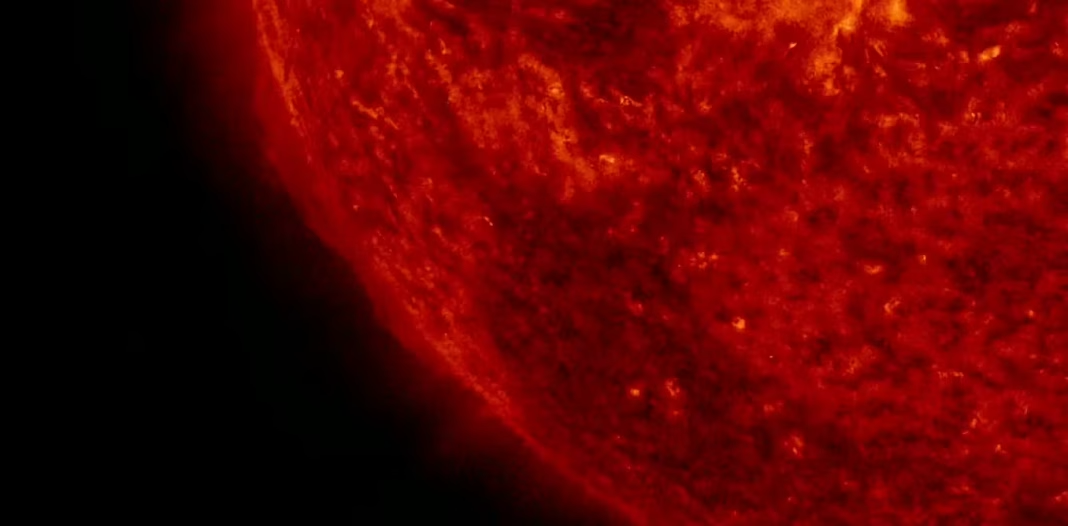

When you look up at the sky on a sunny day, the Sun might seem like a bright spot, unchanging in the sky. But the Sun is a complex, dynamic celestial body, wrapped in electrical currents and magnetic fields that constantly move and tangle as it rotates. At times the Sun’s surface is very active, casting out powerful bursts of plasma called coronal mass ejections, while at other times it is calmer.
I’m a solar physicist who has spent over a decade researching the Sun. Its movement and activity is directly linked to conditions on Earth: Solar flares and ejections can cause space weather that produces beautiful Northern lights but threatens satellites. This activity follows a roughly 11-year-long cycle, and learning about this cycle helps researchers predict future space weather.
Inside the Sun
The Sun is a star composed of plasma: a hot, ionized gas. The plasma acts as an electrically conductive fluid, and generates large-scale magnetic fields that encircle the Sun.
The Sun is composed of several layers, all made up of a plasma that’s about 70% hydrogen and 28% helium by mass.
The Sun has a solid core at its center and a dense layer outside the core, where particles of light bounce around, transferring energy outwards. Beyond that layer is a thin line called the tachocline that separates those inner layers from the outer layer. This outer zone is cooler and less dense, allowing plasma to move around.
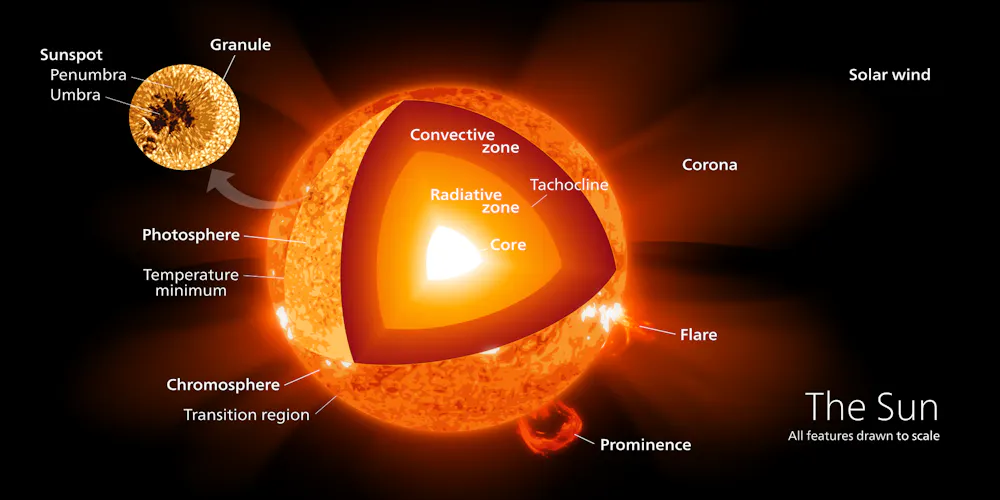
Kelvinsong/Wikimedia Commons, CC BY-SA
Inside the core, particles collide and release incredible amounts of energy, which radiate out from the Sun in the form of light – a process called nuclear fusion. The light travels outward towards the radiative zone outside the core, before reaching the tachocline.
At the outer layer of the Sun above the tachocline, called the convective zone, the hot plasma travels from deep in the Sun to its surface. As it moves, the plasma cools and contracts, causing it to sink back down. This cyclic process is called convection.
The Sun is constantly generating magnetic fields that grow and twist below its surface. Two processes control these magnetic fields by moving the electric charges around in the plasma. One is convection, and the other is the Sun’s rotation.
Scientists think that together, these two processes are ultimately responsible for the Sun’s magnetic activity cycle, during which the Sun shifts from an organized to a less organized magnetic field arrangement. The entire cycle, called the Schwabe Cycle, takes roughly 11 years. Over the course of two Schwabe cycles, the Sun’s magnetic poles flip, and then return to their original orientation.
The Schwabe cycle
When the Sun is in an organized state, the center of the Sun resembles a giant vertical bar magnet with positive and negative ends at the top and bottom, or vice versa – called a magnetic dipole. In the 11-year solar cycle, this phase is known as solar minimum.

NSF/AURA/NSO
Although you cannot see the invisible magnetic field directly, the glowing plasma sticks to these field lines. The magnetic field’s shape during the solar minimum is similar to Earth’s magnetic field, with open-ended magnetic field lines at the north and south poles and closed, looped fields near the equator. After the solar minimum state, the Sun’s magnetic field grows tangled over time. Eventually, it reaches its solar maximum state, where the solar atmosphere resembles tangled up spaghetti.
Two main forces tangle the magnetic field as the Sun rotates and plasma churns away in the convection zone: the Omega and Alpha effects.
Alpha and Omega effects
The Sun doesn’t rotate as a solid body everywhere. The interior of the Sun – the core and radiative layers – spins as a solid sphere, like a basketball. Outside these layers, the convection zone and the surface of the Sun do not spin all together.
By observing the Sun’s visible surface, scientists found out that the solar equator in the center rotates faster than the poles, near the top and bottom of the Sun. It takes the solar equator about 25 days to make a full rotation, while the poles take longer – about 35 days. Because the equator moves faster, it overtakes the poles in a phenomenon called differential rotation.
Differential rotation stretches the vertical magnetic field lines around the Sun, causing them to wrap around the Sun horizontally like a belt. The field lines pull on the Sun more tightly as differential rotation continues throughout the solar cycle, in a process known as the Omega Effect.
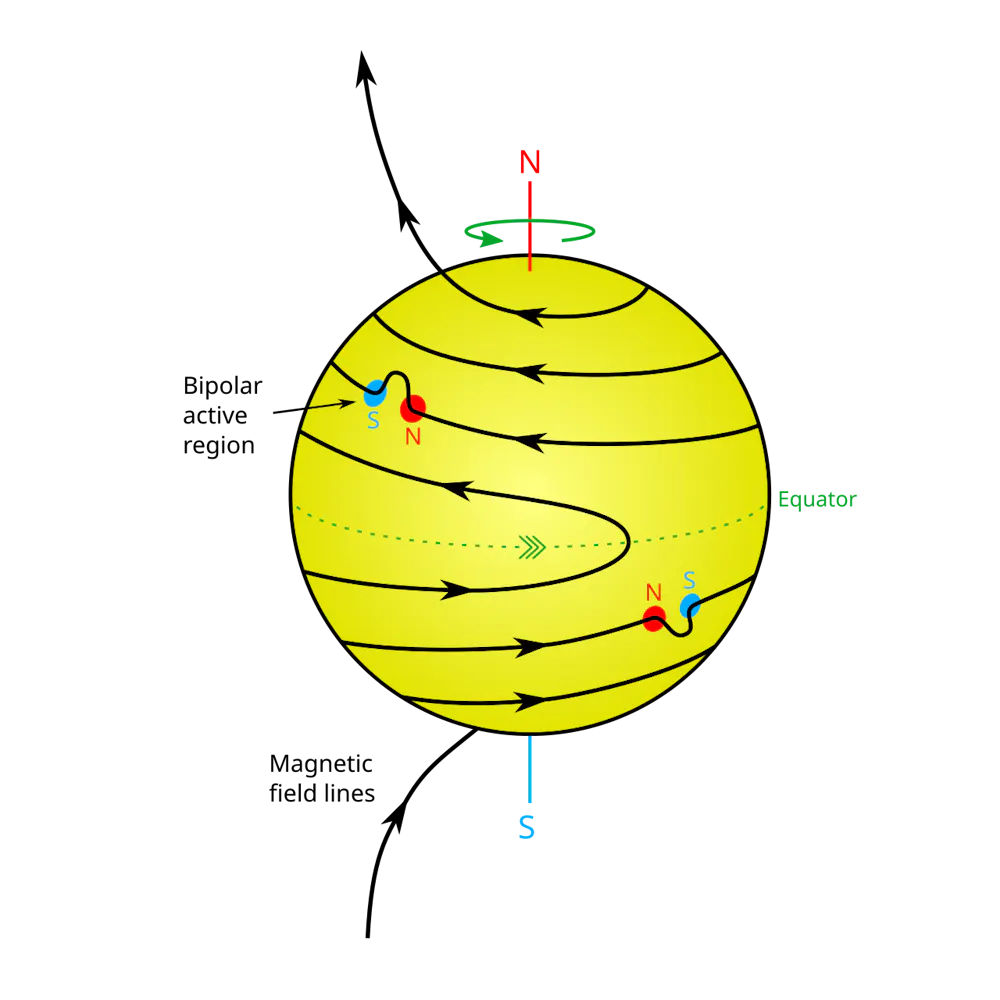
CoronalMassAffection/Wikimedia Commons, CC BY
The second effect, called the Alpha Effect, is thought to arise from convection taking place below the Sun’s surface coupled with its rotation. Like bubbles rising to the surface in boiling water, the tangled magnetic field becomes buoyant and kinked, popping through the surface to create sunspots.
Sunspots look like clusters of dark spots on the Sun’s surface. Scientists can also identify active regions of intensely strong and complex magnetic field bundles by taking images of the Sun in ultraviolet light, where the bundles appear as bright structures.
Solar eruptions called solar flares and coronal mass ejections occur most frequently in these active regions. The appearance of more sunspots, active regions and solar eruptions all signal to scientists that the Sun is entering its solar maximum phase.
Moving magnetic poles
Over the course of the solar cycle, the Sun’s magnetic poles move. At solar minimum, the magnetic poles are oriented vertically through the Sun’s center. But over the course of the solar cycle, the poles begin to tilt, until the pole previously at the top of the Sun is pointed roughly at its equator.
But at the same time, all the tangled magnetic fields make the poles less defined. This chaotic magnetic state partially leads to sunspots and solar eruptions. After solar maximum, as the Sun’s magnetic state grows more organized again, the poles reappear and continue migrating back towards the top and bottom of the Sun.
However, the magnetic pole previously pointed at the top now points to the bottom, and vice versa. The configuration appears upside down from what it was 11 years ago. A full magnetic cycle takes two Schwabe Cycles – during this time, the Sun’s poles flip twice and return back to the original orientation.
Scientists have observed that several other stars, not just our Sun, have a magnetic activity cycle, though their duration can vary. And, like our Sun, other stars also produce eruptions like stellar flares and coronal mass ejections, likely due to their activity cycles.
Studying magnetic cycles in other stars can help astronomers determine whether distant planets could support life. A star’s magnetic activity directly dictates the amount of space weather the planets around that star experience. These effects can strip away the protective atmospheres around planets, prohibiting them from supporting life.