


Strange as it is to say, the U.S. Declaration of Independence has deep roots in Canada.
That assertion may come as a surprise to people in the United States ahead of its 250th anniversary. The common narrative is fixated upon 1776, the 13 rebelling Colonies and the bold military actions of Founding Fathers such as George Washington.
But as I document in my new book, “Freedom Around the Globe,” there is a much wider and often forgotten geographical context. Indeed, it is impossible to understand fully the trajectory of the U.S. in 1776 without comprehending a wider imperial world and what happened in 1775. In fact, the American Revolution ran through Canada.
A broader British North America
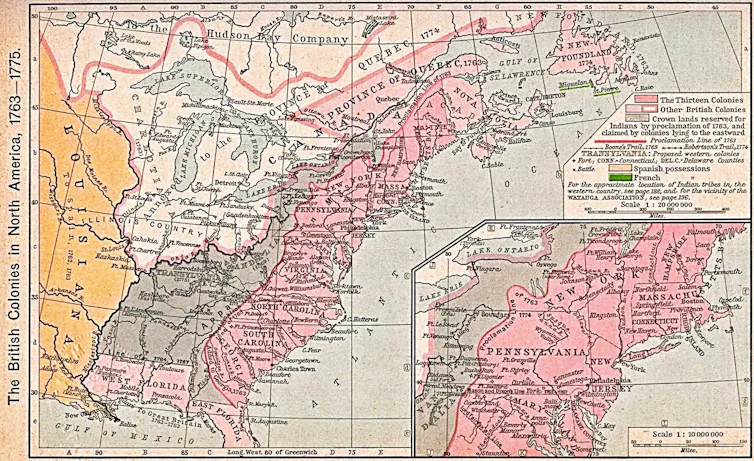
In 1775, the first year of the American Revolutionary War, Britain possessed double the famous 13 colonies in North America alone, with many in Canada and the Greater Caribbean – including East and West Florida.
At least some of these colonies had become nominally British in the 1760s, thanks to military triumph late in the Seven Years’ War, 1756-1763. In late 1759, the British had vanquished the French at the battle of the Plains of Abraham near Quebec City, thus ensuring that the British gained this province and a string of French forts in the interior.
In 1763, with the Treaty of Paris, Quebec officially became part of the British Empire. It took British bureaucrats and politicians some years and not a little wrangling to figure out how to integrate French and Indigenous Catholics, with their own laws, into the British Empire.
A major milestone in this process was the Quebec Act of 1774, allowing the practice of Catholicism and modified French law in Canada. Colonists down south, especially fierce New England Protestants who took a dim view of Catholicism, viewed this act – and their new fellow imperial subjects – with dismay and considerable suspicion.
Universal History Archive/Universal Images Group via Getty Images
Pushing for a 14th colony
Still, by 1775, those in the 13 Colonies who called themselves “Friends of Liberty” hoped that Canada would “complete the union of 14 provinces,” as one man put it. Accordingly, the First Continental Congress wrote to Quebec’s habitants – residents of French origin – to invite them to join their new nationalist project. The letter explained in patronizing terms how the English government worked.
The Congress acknowledged that there were religious differences with French Catholics but expressed confidence that the “transcendent nature of liberty” could overcome such distinctions. They commissioned its translation into French and ordered a thousand copies for Canadian distribution. By early 1775, Quebec’s governor complained that this letter was stirring up the population by planting dangerous doubts about British imperial authority.
On May 1, 1775, the day the Quebec Act took effect, the life-size marble statue of George III in Montréal – erected in gratitude for his assistance following a fire – was vandalized, indicating disquiet there about this new order.
The Second Continental Congress, which followed the first after its dissolution, continued efforts to win over French Canadians. They sent another letter, again translated and widely distributed. “We yet entertain hopes of your uniting with us in the defence of our common liberty,” they pleaded. The Continental Congress urged Canadians to reject “the fetters of slavery, however artfully polished.” Signed by “Jean Hancock, le “Président du Congrès,” this missive prompted discussions among people in Canada.
The invasion of Canada
As 1775 wore on, force came to join careful letters.
One Boston newspaper proclaimed: “From the friendly disposition of the Canadians … joined to the intrepidity of the Continental army, there is a fair prospect of the speedy reduction of the metropolis of Canada to … obedience.”
It was a cheering if jumbled message: Canada a metropolis? Friendly French Catholic enemies? Allies reduced to obedience? Nothing in it quite made sense, but few in those “United Colonies” – not yet states – wanted to think too hard about these claims or their implications.
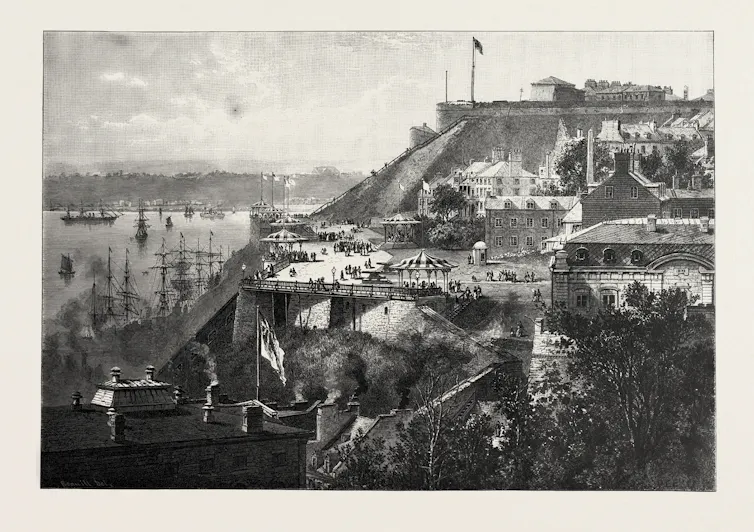
Quebec was “easy Prey,” pronounced George Washington in September 1775. He put the well-regarded, Irish-born Gen. Richard Montgomery in charge of the conquest of Canada. Montgomery and his troops managed to take Montréal at the end of November. The British monarchy looked to be toppling in Canada. That marble sculpture of George III, vandalized in 1775, was now beheaded altogether, to the cheers of soldiers. The next step was to join forces at Québec to take that city and thus the province.
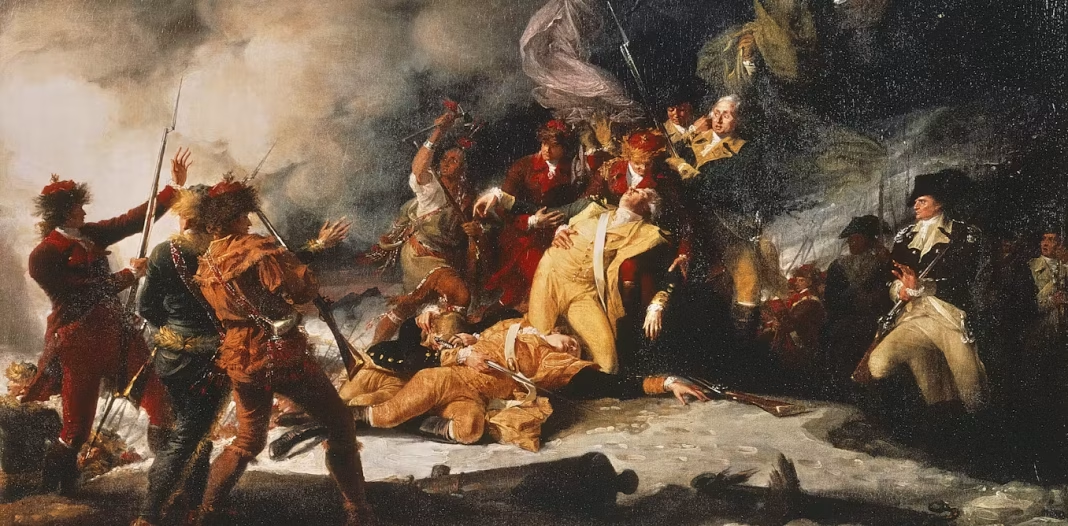
December was not a good time to launch a Canadian siege. However, the terms of thousands of soldiers expired on Dec. 31. So Continental Army leadership forged ahead on the last, short, dark day of 1775. A blizzard made conditions horrific. Even Montgomery fretted that his forces were “half-starved and half-naked.” Still, rank-and-file soldiers did what they could. Pinned to their random assortment of hats were scrawled, handmade signs proclaiming liberty or death. They mostly got the latter.
Montgomery was killed within the first few hours on Dec. 31, 1775. His men were left to fight for themselves, as one private, Jeremiah Greenman, wrote in consternation as he found himself – like one-third of his fellow Continental soldiers – a prisoner of war.
Universal History Archive/Universal Images Group via Getty Images
The move to independence
The attack on Quebec was a disaster. The icy cold was fatal. Supplies were insufficient. Smallpox raged among malnourished troops. The Canadian catastrophe highlighted the inadequacies of the current system of supply and the lack of American credit. Soldiers, starving and frustrated, did not behave especially well, thus turning Canadians against the cause.
Perhaps unsurprisingly, subsequent attempts at diplomacy, led by the ailing diplomat and intellectual Benjamin Franklin, also proved ineffective. As one Continental officer later declared, “We have bro’t about ourselves by Mismanagement” what the British could not: the near-complete loss of Canadian support.
In January 1776, news of the defeat shocked colonists. Montgomery’s death provoked an outpouring of heartfelt support. Marylanders showed their adoration by naming Montgomery County for him.
That same month, in Philadelphia, an English-born printer published a treatise, dedicating partial profits “for mittens for the troops that were going to Quebec.” That would have been a lot of mittens, because the publication was the bestselling pamphlet of 18th-century North America: Thomas Paine’s “Common Sense.”
The death of an Irishman in Canada propelled many Americans to agree with this Englishman Paine that independence was the right course. As one put it, “Poor Brave Montgomery! But it is not a time to cry but to revenge.” Paine capitalized on the momentum by publishing a dialogue between Montgomery’s ghost and an American in February, debating independence. In the glum mood of early 1776, Paine’s arguments landed.
Grave loss in Canada precipitated the Declaration of Independence, created with an eye to France and Spain as allies. To obtain the help it needed, the newly named United States of America had to become an independent nation. Few countries would intervene in a colonial rebellion, but they might join a war against the hated British. As Montgomery’s brother-in-law observed, France was a good prospect for “foreign aid” to the fledgling nation.
Indeed, assistance – in terms of finances, arms and, eventually, soldiers – from France and Spain would make all the difference, allowing Washington and others to move from defeat to victory. The momentum that resulted in the Declaration of Independence came in part from Canada.