


Lately, much of the news about the Arctic has been bleak. The far north is warming three to four times faster than the rest of the planet. Arctic climate change – manifesting in sea ice loss, permafrost thaw and coastal erosion, among other phenomena – is already causing serious problems for Arctic residents, ecosystems and the rest of the planet.
At the diplomatic level, Russia’s invasion of Ukraine in 2022 has had spillover effects in the Arctic, raising tensions and causing a breakdown in cooperation among the Arctic countries. The Trump administration’s interest in Greenland, along with its combative approach to NATO, has roiled relations among Arctic allies. The Arctic Council, established in 1996 to promote cooperation among the Arctic states, significantly scaled back its operations after the Russian invasion.
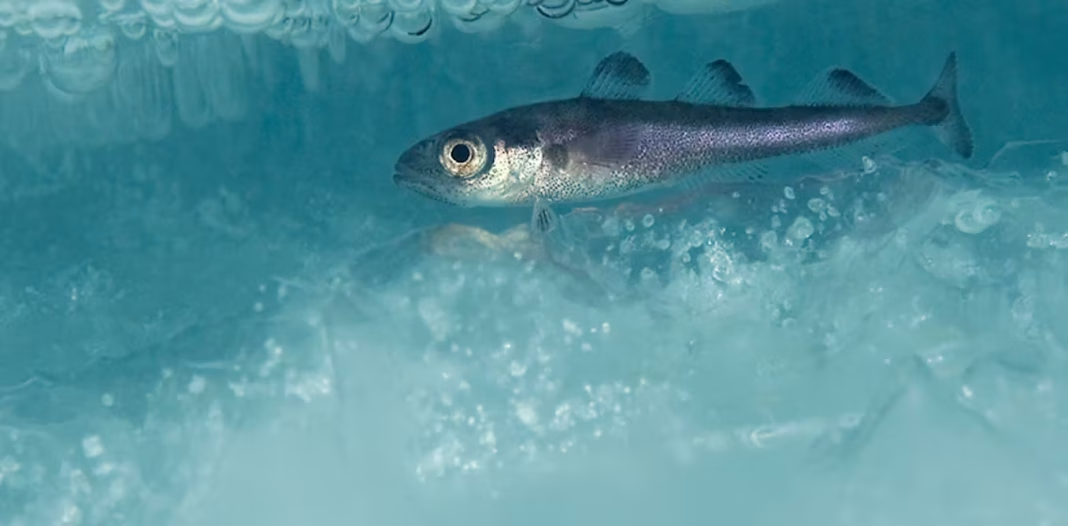
But there is a bright spot. Five years ago, the United States, Russia and China joined six other nations and the European Union to bring into force a new treaty – the Central Arctic Ocean Fisheries Agreement – to keep commercial fishing out of the region, at least for now.

© Pew Charitable Trusts
The agreement’s moratorium on fishing remains in place today, and the parties to the treaty, including Russia, continue to work together to advance scientific understanding of the Arctic Ocean under the treaty, despite other tensions in the region.
While serving in the U.S. State Department, I chaired the negotiations that produced this treaty. It’s useful to look at why this unusual pact came together, why it still works, and whether it could serve as a model for future diplomacy in the Arctic.
The need for precaution
At the heart of this treaty, and part of what can make it a good role model, is a tenet of modern international law known as the precautionary principle, or precautionary approach. In fact, it may be the best example of it that I’ve ever seen in international law.
In the context of managing international fisheries, this tenet calls upon governments to “be more cautious when information is uncertain, unreliable, or inadequate.” Unlike many treaties, including past fishing treaty failures, the countries agreed to take action in advance, before commercial fishing could become a problem.
Commercial fishing has never taken place in the Central Arctic Ocean. That’s because the area was completely covered by ice as far back as records exist, until recently. Today, as temperatures quickly rise in the Arctic and sea ice declines, a significant portion of the Central Arctic Ocean – the ocean’s international waters – is open water for part of each year.
Nobody can say what effect commercial fishing might have on the ecosystem in this region, given the dearth of scientific knowledge about the Arctic Ocean.
In the face of such uncertainty, this treaty – applying the precautionary approach – delays the start of commercial fishing until governments have adequate information to manage fishing sustainably. The treaty also sets up a research program to study and monitor the Central Arctic Ocean.
US leadership fostered international cooperation
The origins of the agreement trace back to a bipartisan effort in the United States that may be difficult to imagine now. In 2008 Congress passed a joint resolution, signed by President George W. Bush, calling for a Central Arctic Ocean fisheries treaty.
Under President Barack Obama the United States convened two sets of international negotiations. The first round aligned the views of the United States and the four other countries that have coastlines on the Central Arctic Ocean: Canada, the Kingdom of Denmark, Norway and Russia. Next, the negotiations expanded to include Iceland and others with large, distant-water fishing fleets: China, Japan, South Korea and the European Union.
The treaty is also one of the best examples of a binding international agreement that requires incorporating Indigenous knowledge and the involvement of Arctic Indigenous peoples in its implementation. I believe the negotiations would not have succeeded without the involvement of Indigenous and other nongovernmental experts and groups, including scientists, industry leaders and environmental organizations.
The resulting treaty entered into force in 2021. The United States signed and ratified the agreement during President Donald Trump’s first term.
Each country has something to gain from cooperation. For the United States, the agreement extends the successful model of fisheries management off Alaska to the high seas and helps limit foreign vessel activity in the region. For countries that don’t border the Arctic Ocean, such as China, Japan and South Korea, the treaty gives them international recognition as Arctic players. At the same time, the treaty doesn’t preclude future commercial fishing in the Central Arctic Ocean, but instead allows time to ensure any fishing there can be sustainable.
A rare venue with Russia
The 10 parties to the treaty have met each year since 2022 to implement the agreement. They have advanced scientific research in this little-known part of our planet and are developing rules for very limited “exploratory fisheries” to study the migration of fish into the Central Arctic Ocean.
The fact that these meetings are taking place at all is an anomaly. In contrast to the Arctic Council, the conferences of the parties to this treaty have involved Russian experts each time, including during a meeting taking place June 16-17, 2026, in Brussels.
Despite the geopolitical turmoil in the world, those working to implement the treaty have put aside their differences to pursue their common interests concerning the Central Arctic Ocean.
Looking ahead
That willingness to set aside differences in pursuit of common interests can have many benefits.
Even during the Cold War, the United States and the Soviet Union worked together on a wide range of issues, including a joint effort to spearhead the Antarctic Treaty, which has kept Antarctica demilitarized and facilitated scientific advancements at the Earth’s other pole.
After the Cold War ended, the Arctic also became a region of exceptional East-West collaboration. Nations cooperated to protect the Arctic environment, to promote economic development, to bolster search-and-rescue capacity and to improve scientific understanding.
The current breakdown in cooperation with Russia is, on one level, entirely understandable, given the desire to maintain pressure on Russia to end the war in Ukraine. However, the Arctic Ocean is facing new challenges, with commercial shipping increasing as the ice melts and the rising potential for seabed mining, each of which poses unknown risks to its environment.
I believe the Central Arctic Ocean Fisheries Agreement could serve as an inspiration, maybe even as a road map, for the path back to a cooperative, well-managed Arctic region, if countries follow its example.



