



Curious Kids is a series for children of all ages. If you have a question you’d like an expert to answer, send it to CuriousKidsUS@theconversation.com.
Why can some organisms (like planaria or salamanders) regenerate limbs, while others cannot? – Anna, age 12, Kansas City, Missouri
Imagine losing an arm and simply growing a new one. This amazing ability of regeneration isn’t just something from a superhero movie – it actually happens in real life for some animals.
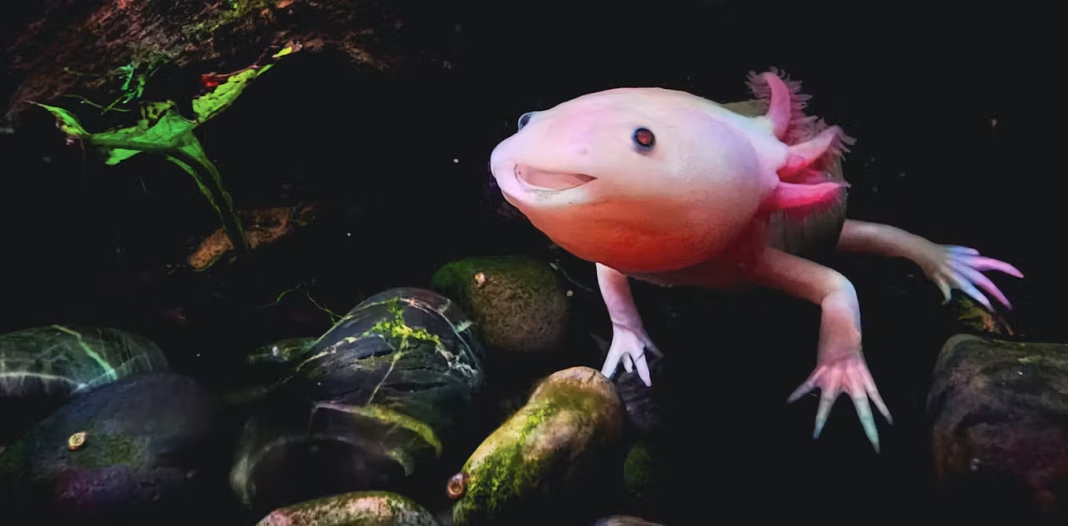
Salamanders are known as champions of regeneration. If a salamander loses a leg, it can regrow another one, complete with bones, nerves, blood vessels and muscles.
Some fish are impressive regenerators too. Zebrafish – small, striped fish that scientists often use to study human diseases – can regenerate injured fins. Even more surprisingly, they can repair damaged parts of important organs such as their heart and brain.
Why can these animals regenerate while people cannot?
How regeneration works
If you suffer a severe injury, such as losing your hand, your body quickly works to close the wound and prevent infection. However, you cannot regenerate that lost hand. Instead, the wound heals and leaves a scar.
Regenerating animals respond differently to injury. The bodies of these animals close the wound, but they go a step further by activating a cellular and molecular regeneration program. Cells near the injury begin to communicate with one another. Some become signaling cells that send out messages to activate other cells. The cells receiving these signals produce new cells that help rebuild the missing tissue.
When salamanders need to regenerate their limbs or zebrafish their fins, injury cues preexisting cells to return to a more premature state to form a structure called a blastema. You can think of the blastema as a temporary construction zone filled with cells that multiply to provide the building blocks needed to rebuild the missing tissue.

Suzuki et al/The Scientific World Journal, CC BY-SA
But rebuilding a limb is much harder than simply making lots of new cells. The new limb has to grow into the right shape and reach the right size. These new cells also need to “remember” where they came from so that they can mature into their appropriate cell types, such as bone-forming cells, muscle cells or blood vessel cells.
These new cells also need to know when to stop multiplying. If an animal loses only the end of a limb, for example, it should replace only the missing part – not grow an entirely new limb on top of the old one. Uncontrolled cell growth could also lead to cancer. Regenerating animals have remarkable ways of turning cell growth on when it’s needed and shutting it off once the missing tissue has been rebuilt.
Nerves play an important role for regenerating limbs. After an injury, nerves send out signals to help form a blastema. Without enough nerve signals, regrowth can slow down or stop, and the limb may fail to regenerate. Scientists have even found that rerouting a nerve to a wound can lead to the formation of an extra limb.
Regeneration trade-offs
If some animals can regenerate their limbs, why can’t humans regenerate an arm or leg?
Humans actually do have some regenerative abilities. Your skin constantly replaces old cells, your blood cells are continually renewed, and your liver can regrow considerably if part of it is removed. Young children can even regenerate the tips of their fingers under certain conditions.
Researchers are still trying to figure out why humans can’t regrow limbs like some other animals can. Zebrafish provide an interesting clue: Their fins are usually excellent at regenerating, but the pectoral fins of adult males don’t regenerate as well. Male zebrafish develop special structures on their pectoral fins that help with reproduction. Keeping these structures can inhibit the ability of their fins to regenerate.

Pogrebnoj Alexandroff/Wikimedia Commons, CC BY-SA
This finding suggests that evolution sometimes involves trade-offs. An animal may gain specialized features that help it survive or reproduce, but those same features can come at the cost of regenerative ability.
Harnessing regeneration for healing
Scientists are studying highly regenerative animals to uncover their secrets. We are exploring questions like: What signals tell existing cells to change their identity and help rebuild missing tissues? How do these cells know what to rebuild and when to stop regrowing? And can some of these biological instructions be activated in animals that normally regenerate poorly, including people?
For example, my lab explores how nerves control regeneration and how injuries turn on genes needed for regeneration. The lab of my colleague Deneen Wellik investigates how certain genes guide regeneration, while the lab of my colleague Ken Poss explores whether the lessons we learn from studying highly regenerative animals can be applied to mammals.
By studying animals that can already accomplish the remarkable feat of regrowing body parts, researchers can learn the fundamental rules of regeneration – and perhaps one day use those lessons to improve tissue repair in humans.
Hello, curious kids! Do you have a question you’d like an expert to answer? Ask an adult to send your question to CuriousKidsUS@theconversation.com. Please tell us your name, age and the city where you live.
And since curiosity has no age limit – adults, let us know what you’re wondering, too. We won’t be able to answer every question, but we will do our best.