


Imagine shining a flashlight across a dark room. You can predict exactly what the light will do: travel in a straight line from one point to another. That seems obvious, because in the world we see around us, light appears to follow a single, clear path.
Quantum mechanics paints a far stranger picture.
If you zoom in to the atomic scale, light does not behave as though it follows only one straight route. Instead, a particle of light explores every path available to it at once. One path may indeed be the straight line across the room. But others could involve the light bouncing off walls, curving through the space or tracing wildly improbable detours before reaching its destination.
In a sense, nature keeps all these possibilities “alive” simultaneously. One outcome emerges only after the light is “observed,” or a measurement is performed. The path you observe – usually the straight line – is simply the most probable result after all the possible paths interact, making some outcomes more likely and others less likely.
This idea feels almost impossible from the perspective of everyday life, yet it lies at the heart of quantum mechanics. Today, scientists like me are learning how to harness these strange quantum effects to build an entirely new kind of machine: the quantum computer.
Superposition
In daily life, physics is straightforward. A tennis ball is either sitting on a table or not. A light is either on or off. Even if you’re in another room and don’t know which it is, the object itself already has a set state.
Quantum mechanics doesn’t follow these usual rules. Within the laws of quantum mechanics, the results are not fixed until someone observes them.
At very tiny scales, particles don’t have definite states. Instead of being one thing or another, they exist in a state that isn’t decided yet. This isn’t because you’re missing information, it’s because the reality itself hasn’t settled.
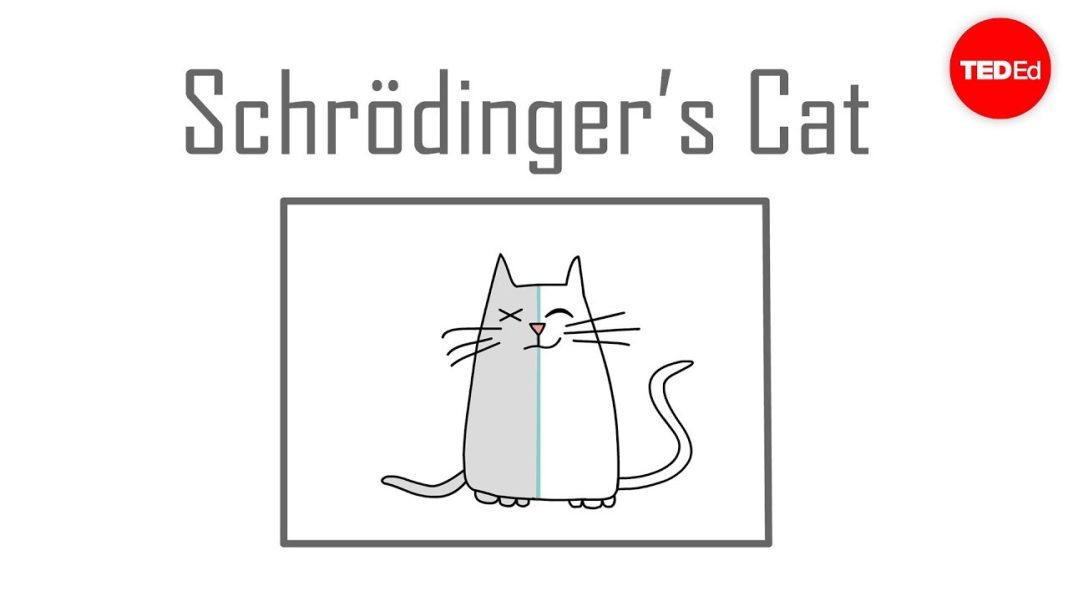
Electrons, photons and atoms can be in a superposition: a state that mixes several possible states. The particle can be here, there or somewhere in between. Schrödinger’s cat is a famous example: A cat in a closed box, linked to a quantum device, is both alive and dead until someone checks.
As strange as this sounds, superposition has been repeatedly confirmed in laboratory experiments. Yet these quantum states are extremely fragile. Interactions with the outside world – such as heat, vibrations, stray electromagnetic fields or even accidental contact with surrounding particles – can destroy the delicate superposition, forcing the system into a single state.
Physicists call this process decoherence. A quantum system behaves somewhat like a spinning coin. While the coin is still rotating in the air, it is not settled into heads or tails from our perspective; both outcomes remain possible. In quantum mechanics, particles can exist in a similar kind of mixture, a superposition where several possible states coexist at once.
Only when a measurement is made does the system “choose” a definite outcome, much like the spinning coin finally landing as either heads or tails.
Physicists refer to this process as collapse, but scientists have not yet solved the fundamental enigma that drives this phenomenon. Imagine streaming music. The data stays in its original form until you start the streaming service, which can play any song. Pressing play turns that potential into a real song. Measuring quantum particles produces a similar effect by forcing all possible results to collapse into a single, actual result.
Spooky friendships at a distance
Superposition is not the only strange feature of quantum mechanics. Another is entanglement: a phenomenon that appears when two particles interact in such a way that their properties become deeply linked, even when separated by large distances.
When two particles interact in a certain way, they can become entangled. This means that measuring one instantly tells you something about the other, no matter how far apart they are. Einstein didn’t like this idea and called it “spooky action at a distance.” He thought quantum theory was missing something. But after many experiments, scientists have shown that quantum entanglement is real.
A good way to visualize this is to think of two dancers. After lots of practice, they can match each other’s moves on different stages without talking. Their perfect timing comes from the routine they learned together.
From weirdness to a new kind of computer
So, what does all this mean for the future of computers?
A normal computer, like the one on your desk, uses bits. Each bit is either zero or one, like a light switch. All your photos, videos and messages are just long strings of these switches. But a quantum computer uses qubits. Because of superposition, a qubit can be zero, one or a mix of both at once. Two qubits can encode four possibilities at the same time; 10 qubits can encode 1,024; and 300 qubits can represent more states than there are atoms in the universe.
Quantum computers aim to perform certain calculations far faster than classical computers, but current systems still face major limitations in speed, stability and computational capacity.
A standard computer operates like a runner who must navigate each maze path by sequentially checking every route. Quantum states evolve so that useful computational paths reinforce each other, guiding the system toward the correct outcome.
Quantum computers are not practical for email operations, spreadsheet management and streaming content; the existing classical computers are good enough for these tasks. Quantum computers’ true potential lies in solving problems that are too complex even for the most powerful classical computers in the world.
These tasks include simulating how molecules interact to help scientists design new drugs, discovering materials that could improve technologies such as solar panels and batteries, and advancing fields such as cryptography.
The locks of the internet and their keys
Almost all private information sent online – bank logins, medical records personal messages – is protected by Rivest-Shamir-Adleman, or RSA, encryption, one of the most widely used methods for securing digital communication. RSA relies on multiplying two big prime numbers. It is secure because while it is easy to multiply these, it would be very difficult to take the result and work backward to determine which primes were used. A regular computer would need billions of years to break a strong RSA key by guessing.
In 1994, however, mathematician Peter Shor demonstrated that a sufficiently powerful quantum computer could solve this problem in just a few hours. Today’s quantum computers aren’t yet big enough, but fast progress means we might see this happen in the next 10 to 20 years.
Because of this progress, security experts have warned about a “harvest now, decrypt later” approach. Hackers are already gathering encrypted data, hoping that upcoming quantum computers will let them unlock it. For instance, medical records from 2026 might be at risk in 2040.

Dev Jadiya/Wikimedia Commons, CC BY-SA
Quantum mechanics doesn’t just threaten current security systems – it also enables new forms of protection. Quantum key distribution could leverage the delicate properties of quantum states to detect eavesdroppers. If someone tries to intercept a quantum message, it would change the system and leave clear signs of tampering.
Chinese researchers demonstrated quantum key distribution over satellites in 2017, and governments worldwide are now working on quantum-safe networks.
But these advances also bring ethical questions. The same quantum tools that can help scientists understand proteins could also be used to spy on private messages. The first countries and companies to build quantum computers that can outperform classical computers will have significant power over others.
This change could become as important as the invention of writing or nuclear technology. The technology itself isn’t good or bad – what matters is how people use it.
Where we actually are
In 2019, Google said its Sycamore processor did a certain calculation in 200 seconds. The team estimated that a typical supercomputer would take 10,000 years to perform the same task. Some people questioned the claim, and the calculation wasn’t very useful, but it was still a big step – a real example of “quantum benefit.”
Right now, IBM, Google and IonQ, as well as many universities, are working to build larger and more dependable quantum computers. The main problem is that qubits are extremely fragile. Even tiny things like vibrations, stray light or small temperature changes can mess up their state. Most quantum computers have to be cooled to temperatures even colder than outer space.
Quantum computers probably won’t replace your desktop computer or speed up your daily computer tasks. But they are part of a technological revolution that could improve medicine, materials science and cybersecurity. That impact will likely come gradually: In the near term, quantum computers will remain specialized research tools, but over the next decade or two they may begin to play a practical role in different areas.