


Nearly 10 months after agreeing to the first phase of a ceasefire, Israel and Hamas are being compelled – somewhat reluctantly – to move to “phase 2.”
On July 30, 2026, President Donald Trump announced that Hamas had accepted to disarm and transfer security and civilian affairs in the Gaza Strip to a technocratic Palestinian administration – a key requisite of phase 2 of the U.S.-brokered peace plan for Gaza, along with the withdrawal of Israeli troops from the enclave. Trump’s Board of Peace published a road map the following day for how it is to be achieved.
To Trump, it was a a “major milestone” toward lasting peace. But as an expert on Palestinian politics, I see major impediments to implementation. The move to “phase 2” comes despite “phase 1” being less than wholly successful. Since the ceasefire was signed on Oct 9, 2025, Israel has killed more than 1,100 Palestinians and shifted the “yellow line” behind which its forces were due to withdraw from an agreed-upon 53% of Gaza territory to now over 65%. Meanwhile, the daily life conditions for Palestinians in the enclave have largely not improved.
Moreover, it is unclear how committed Hamas and Israel are to the next stage. For now, neither can agree on a sequence: Hamas says no disarmament without Israeli withdrawal; Israel insists no withdrawal until disarmament.
Strong-arming Hamas
With little progress in improving living conditions in Gaza and with Israel continuing to kill its operatives, Hamas has faced intense pressure in recent months to make further concessions. Amid a reportedly heated internal deliberation, Hamas decided that disarmament appears now as the least costly path for its movement – and for the 2 million Palestinians stuck in Gaza.
The breakthrough required intensive pressure by outside mediators from Egypt, Turkey and Qatar on Hamas to accept the Board of Peace High Commissioner Nickolay Mladenov’s road map to phase 2.
It also only happened after Hamas had completed its internal elections and elected Khalil al-Hayya chairman of its political bureau. The previous Hamas committee, established after the death of Yahya Sinwar, had no consensus among them and could not deliver on consequential issues.
And even then, the breakthrough could not have happened without the direct intervention of Mohammed Dahlan. Originally from Gaza, the United Arab Emirates-based exiled former Fatah leader is an influential businessman, powerbroker and top adviser to UAE President Sheikh Mohammed bin Zayed Al Nahyan. He has invested time and effort in helping Palestinians in Gaza by sending food and medical supplies, paid for by his host country.
Despite being a senior leader of a rival party, Dahlan has pledged to try to bridge the gap between Hamas and rival factions. At the same time, he also cuts a controversial figure due to his perceived closeness to the American and Israeli establishments, his falling out with current Palestinian Authority leadership and his heavy-handed tactics when he led security efforts in Gaza before Hamas took charge there in 2007.

Lior Mizrahi/Getty Images
Yet for the people in Gaza now, it appears the hope of relief and recovery supersedes political bickering. Dahlan – coordinating his efforts with Jared Kushner, Trump’s son-in-law and a member of the president’s Board of Peace – stepped in and used his leverage to convince Hamas to publicly accept the most contentious parts of the road map that deal with the handover of power in Gaza and Hamas’ disarmament.
Israeli defiance
Now, it appears that Hamas hopes the onus will be on the U.S. and the international community to ensure that Israel complies with phase 2.
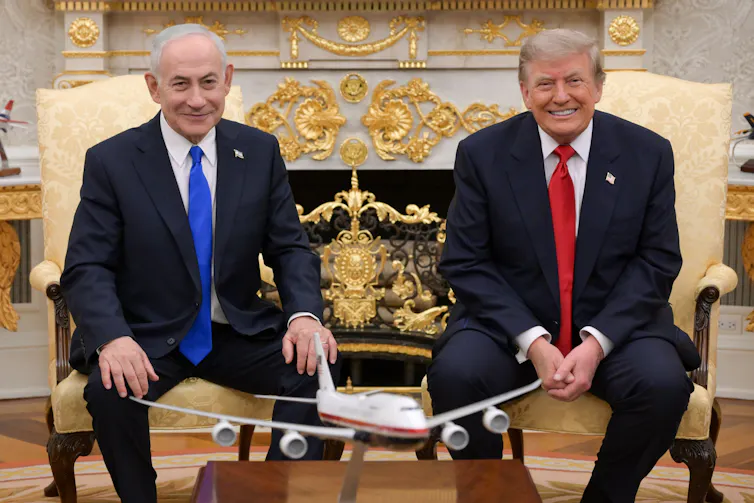
Israeli Prime Minister Benjamin Netanyahu has yet to fully spell out his reaction to the road map. He remains in a delicate position domestically, especially among a cabinet that includes right-wing politicians who believe that even merely symbolic Israeli concessions in Gaza would be tantamount to surrender. Meanwhile, Israeli Knesset elections are scheduled for Oct. 27, and Netanyahu’s popularity has been souring of late.
While largely hewing to Netanyahu’s position, the Trump-sponsored phase 2 agreement still does not allow Netanyahu to declare total victory against Hamas. And anything less would resonate negatively with many Israelis.
But Netanyahu can’t publicly reject it, either, given that Trump has trumpeted the “breakthrough.” As such, Netanyahu has only said that there are disagreements between him and the Trump administration regarding Gaza.
Maâayan Toaf (GPO)/Handout/Anadolu via Getty Images
Others in his cabinet go further. Finance Minister Bezalel Smotrich
and Settlements Minister Orit Strook, both far-right politicians, have called on Netanyahu to revoke any approval of the plan and bring the matter to a cabinet vote.
Under the Board of Peace document, the parties have two weeks to finalize a schedule for an agreement that would achieve Hamas disarmament and cessation of Israeli attacks.
Yet Israel’s immediate reaction to the deal was the renewal of intense bombing in Gaza and the death of more than a dozen people, which prompted a rebuke from Mladenov.
The million-dollar question
Hamas’ reluctance and Israel’s defiance points to a key problem in implementing phase 2 of the peace plan for Gaza: a complete lack of trust, evidenced by the fact that post-ceasefire Hamas has remained the chief military force in Gaza, and Israel has never stopped its military campaign and occupation of the enclave.
So why were the Board of Peace and mediators insistent on moving forward with the plan now?
A number of issues appear to be at play. The implementation of the peace plan for Gaza is perhaps the only chance Trump has of burnishing his self-proclaimed image as a dealmaker on the world stage before the U.S. midterm elections. That’s especially true given the unresolved and politically unpopular war in Iran and little progress in finding a solution to the Russian-Ukraine war.
Yet implementing the terms of phase 2 is no easy task. It calls on Hamas to turn over both heavy weaponry such as missile launchers and light weapons, including all guns. It also demands the dismantlement of the militant group’s tunnel network and weapons manufacturing. That is some undertaking: It would require compliance from all members and factions of the group.
But it is more complicated than that. Israel has created and financed Palestinian militias operating in the yellow area under Israeli control. According to the plan, they also must disarm. All Palestinian clans and families in Gaza would also be a target for disarmament, which would have an impact on the future of Hamas and Palestinian armed struggle.
Meanwhile, Israel remains mum on how willing it is to actually withdraw from Gaza and cease its military campaign. To that end, the biggest hurdle facing the implementation of the latest deal is sequencing. Hamas sees the disarmament process as a parallel one to Israel’s gradual withdrawal from the entire Gaza Strip; Netanyahu has stated that there will be no withdrawal from Gaza before Hamas’ full and complete disarmament.
That Israeli position has now been adopted by Board of Peace chief Mladenov – putting Hamas and other Palestinian factions in a very difficult situation.
Behind all the negotiations and disagreements over sequencing are the Palestinians in Gaza themselves. Some are hopeful that the implementation of the plan would alleviate their daily miserable existence and improve conditions. But equally, many have lost hope in the Trump plan, as Israeli bombs continue to turn their homes into rubble.
And the latest road map makes only passing reference to Palestinian self-determination, stating that it aims to “facilitate launching a credible political path that achieves self-determination and Statehood.”
That seems some ways off. For now comes the difficult task of forcing reluctant parties to adhere to a road map with many potential bumps and potholes along the way.