

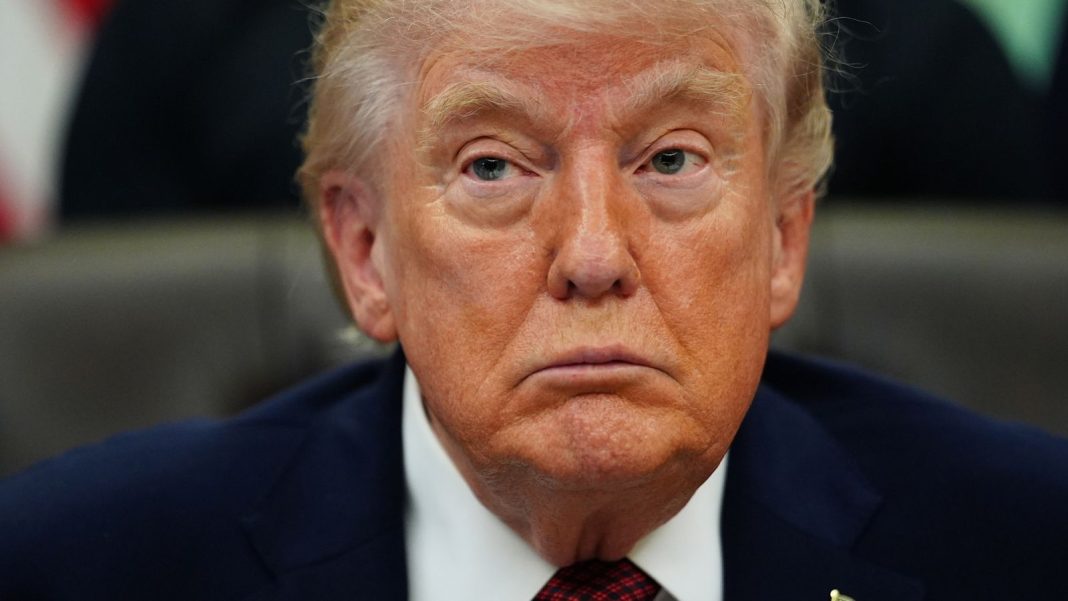

Donald Trump has renewed his threat to “knock out” Iran’s power plants and bridges, unless the Iranian regime reaches a deal to end the war, adding: “NO MORE MR NICE GUY.”
The US president has also revealed he’s sending representatives back to Pakistan for further peace talks. The US delegation will arrive there on Monday evening, according to Mr Trump.
This would not leave long for discussions before the temporary truce ends on Wednesday, but a ceasefire being extended is not an uncommon occurrence.
In a lengthy post on Truth Social on Sunday, the US president responded directly to Iran closing the Strait of Hormuz again on Saturday, which included some attacks on shipping.
Mr Trump had earlier claimed, in another Truth Social post on Friday, that Iran had agreed to never close the strait again.
In the new post, Mr Trump claimed the US “loses nothing” from the closure of the strait, but said Iran was losing millions of dollars.
Mr Trump has warned Iran the US would bomb its power plants before in the conflict, before finding ways to back down from the threat.
Striking power infrastructure is widely condemned by the international community and considered to be a breach of international law.
Mr Trump’s latest post ended with the message: “IT’S TIME FOR THE IRAN KILLING MACHINE TO END!”
Two reasons Iran can keep the Strait of Hormuz closed
The president’s latest intervention is markedly more aggressive than his first reaction to Iran’s closure of the strait.
On Saturday, the US president appeared to shrug it off, saying Iran “got a little cute as they have been doing for 47 years”.
But he also stressed that both sides “have very good conversations going on”.
“They wanted to close up the strait again, as they’ve been doing for years, they can’t blackmail us,” Mr Trump said on Saturday.
Iran said on Saturday it had received new proposals from the US, and Pakistani mediators were working to arrange another round of direct negotiations ahead of the ceasefire deadline.
Iran’s chief negotiator and parliament speaker, Mohammad Bagher Ghalibaf, said progress has been made in negotiations with the US through intermediaries, but that a big distance remains between the two sides.
The war, entering its eighth week, has killed thousands, expanded to Israeli attacks in Lebanon and sent oil prices rocketing due to the de facto closure of the strait that has been in place for the majority of the period.
When the US and Iran declared a temporary truce last week, Pakistan and Tehran said it included Lebanon, but Israel – and later the US – denied this.
Israel then launched a series of airstrikes on central Beirut, prompting Iran to announce it was once again closing the strait.
Following implementation of a 10-day truce in Lebanon on Friday, Iran said it had reopened the strait.
Then on Saturday, Iran reversed the decision, warning it will stay closed until the US blockade is lifted.
Mr Trump has said a US blockade of the strait will remain and attacks will resume if no agreement is reached with Iran.
Iran war day 50: Iran says Hormuz closed
When is the deadline?
The ceasefire is due to run out on 22 April.
No date has been set for the next round of negotiations between Iran and the US, Iran’s deputy foreign minister said on Saturday, noting that a framework of understanding must be agreed first.
The highest-level US-Iran talks since the 1979 Islamic Revolution, which took place in Islamabad last weekend, ended without agreement.
Who is involved?
In Mr Trump’s Truth Social post on Sunday afternoon, in which he mentioned US representatives going to Pakistan, he didn’t say which officials he would be sending to a second round of in-person talks with Iran in Islamabad.
Mr Trump’s main negotiator will be JD Vance, the vice president, who was joined by special envoy Steve Witkoff and his son-in-law and former special adviser Jared Kushner last time.
The pair also negotiated a Gaza ceasefire deal and are involved in Russia-Ukraine talks.
Iranian officials said earlier on Sunday that they were still open to negotiation, but said ships wouldn’t pass the strait while the US blockade remained in effect.
What do we know about the state of negotiations?
One of Iran’s key negotiators has said there is “still some distance” in peace talks as the end of the two-week ceasefire approaches.
The first round of direct talks in Pakistan last week did not amount to much.
Pakistan’s army chief was in Tehran this week, with Pakistani sources telling Reuters he made a breakthrough on “sticky issues” and both sides agree in principle. Pakistan has played a key role as a mediator in discussions between the two sides.
Parsons: Are Iran’s attacks trying to raise the diplomatic temperature?
What do the different sides want?
Mr Trump described Iran’s 10-point proposal as a “workable basis on which to negotiate”.
Mr Trump then posted on his social media site that the ceasefire was subject to Iran agreeing to the “COMPLETE, IMMEDIATE, and SAFE OPENING of the Strait of Hormuz”.
Israel and the US both want Iran’s missile capabilities to be significantly curbed. Tehran has said its formidable missile arsenal will not be the subject of negotiations.
A key objective since the start of the war from Mr Trump is that Iran can never be allowed to develop a nuclear weapon.
However, Tehran says its 10-point peace plan includes Washington’s “acceptance of enrichment” of uranium for Tehran’s nuclear programme.
An Iranian official said last week there are still “highly disputed issues” over Iran’s nuclear ambitions.
Read more:
What is Iran’s 10-point peace plan – and what has Trump said?
Talks break down as both sides play hardball – what happens next?
Iran also said that stopping hostilities in Lebanon will be part of larger peace negotiations.
Israeli Prime Minister Benjamin Netanyahu’s office had said in a statement that a two-week suspension of strikes did not include the war with Hezbollah in Lebanon.
Iran wants the US to unblock Iranian assets and end sanctions that have crippled its economy for years.
The country also wants the withdrawal of US combat forces from the region.
Mr Trump has vowed to retain military assets in the Middle East until a peace deal is reached and warned of a major escalation in fighting if it failed to comply.
‘Iran got a little cute’ says Trump
What is happening between Israel and Lebanon?
Israel and Lebanon agreed to implement a “cessation of hostilities” on 16 April for 10 days, according to a text of the deal released by the State Department.
The deal says Lebanon’s government, with international support, would take “meaningful steps” to prevent Hezbollah and other groups from launching attacks on Israeli targets.
It also says that Israel and Lebanon recognise the country’s security forces “as having exclusive responsibility for Lebanon’s sovereignty and national defence”, referencing a bid by the government since 2025 to disarm Hezbollah.
The deal does not require Israel to withdraw from southern Lebanon, where Israeli forces have been destroying villages and infrastructure after ordering residents south of the Litani River to leave.
US and Iran ‘inching towards an agreement’ despite contradictory claims
What has happened in talks in recent days?
Mr Trump said on Friday there could be talks this weekend and that the two sides were “very close to making a deal”.
He cited “very good conversations” with Tehran despite warning against “blackmail” over the important shipping channel.
Last week, the US and Iran ended an historic round of face-to-face discussions without coming to an agreement.
Tehran reversed course on Saturday to reassert control over the strait, with its closure throwing fresh doubt on the outcome of the war, which the US and Israel launched on 28 February.
Iran said it was responding to a continued US blockade of Iranian ports, adding it violated the ceasefire, while Iran’s supreme leader Mojtaba Khamenei said Iran’s navy was ready to inflict “new bitter defeats” on its enemies.
On Friday, Tehran announced the temporary reopening of the Strait of Hormuz following the 10-day ceasefire.
But Mr Ghalibaf warned that the shipping lane will stay closed if the US continues to block ships from entering and exiting Iran’s ports.
‘I expect things to go well,’ says Trump on Iran negotiations
What happened in the last round of talks?
US vice president JD Vance said negotiations finished without a deal after the Iranians refused to accept US terms to refrain from developing a nuclear weapon.
The discussions in Islamabad began last Saturday, a few days after a fragile ceasefire was announced, and as the war entered its seventh week.
“We were constantly in communication with the team because we were negotiating in good faith,” Mr Vance said, with special envoys Steve Witkoff and Jared Kushner to his side.
“And we leave here, and we leave here with a very simple proposal, a method of understanding that is our final and best offer. We’ll see if the Iranians accept it.”
Mr Trump had said he would suspend attacks against Iran for two weeks.
Mr Vance’s comments did not indicate what will happen after that time period expires or if the ceasefire will stay in place.
What about the Strait of Hormuz?
Iran has doubled down on its pledge to restrict ships passing through the strait as long as the US blockade of Iranian ports remains active.
On Friday, Iran had announced the temporary reopening of the strait, but it was closed again on Saturday evening.
Around a fifth of the world’s traded oil typically flows through the strait every day.
Mr Ghalibaf said in a televised interview that Tehran would continue to threaten commercial vessels transiting the critical waterway.