

It took just a few days for Houthi forces to seize most of Yemen’s Red Sea coast, including the shores of the Bab el-Mandeb Strait, a crucial Red Sea maritime choke point.
The offensive started on Sept. 3, 2026, with a push to cut the strategically important road linking the city of Taiz to the port of Mokha. By Sept. 11, Mokha, the town of Dhubab and the island of Mayyun, in the mouth of the strait, were under Houthi control.
The Yemeni rebel group seized some 2,100 square miles of territory, forcing more than 100,000 people to flee, according to the U.N., with many making the risky journey to nearby Djibouti by boats.
It is the largest shift in the front lines of Yemen’s civil war since a U.N.-brokered truce froze them in April 2022.
Most of the coverage has interpreted the offensive as a new lever for Iran – a key ally of the Houthis – in its ongoing war with the United States, or a fresh threat to Saudi Arabia and global shipping.
Such framing is not wrong, but it is incomplete. The more consequential question, I believe, is what the offensive means for Yemen itself, and where it leaves both a civil war that had quietly stalemated for years and the Houthis’ own unresolved problem of legitimacy.
Why advance now?
Years of Yemeni civil strife entered a new phase in 2014 when Houthis seized the capital Sanaa from the increasingly unpopular government of President Abdrabbuh Mansur Hadi.
A decade of subsequent fighting between the rebel group and a Saudi-led coalition brought famine and destruction across the impoverished nation. But since 2022 the conflict has largely been stalled, with Houthis controlling much of the country’s northwest and the Saudi-backed forces remaining dominant in parts of the country’s south and east.
So why have the Houthis advanced now? The group’s military spokesman, Yahya Saree, said it was triggered by years of Saudi aggression and blockade.
Such grievances are not invented. U.N. agencies have documented real, sustained damage from coalition restrictions on Yemen’s ports and airspace over the course of the civil war.
The Houthis also trace the latest round of fighting to a July 13 strike on the Sanaa airport’s runway by Yemeni government forces with Saudi backing. That attack forced an Iranian aircraft carrying officers of Iran’s powerful Islamic Revolutionary Guard Corps to turn back.
The Houthis declared their ceasefire with Saudi Arabia over that day, struck the airport of the Saudi city of Abha within hours and announced a naval blockade a week later. They then opened a missile campaign in early August, well before the ground offensive on Sept. 3.
But it is hard to read the Houthis’ sustained campaign and the landings on Bab el-Mandeb’s islands as simple payback for an airport strike. Rather, something more deliberate appears to have been in motion.
Another factor is Iran. Since Tehran closed the Strait of Hormuz in March following the U.S. and Israeli strikes on Iran, Saudi Arabia has routed crude oil through Bab el-Mandeb at roughly eight times the rate it did a year earlier.
Houthi control of that strait hands Iran a mirror-image choke point to the one it has over Hormuz. Indeed, Yemeni security sources say a senior Iranian commander, Abdul Reza Shahlai, was on the ground overseeing part of the latest operation in September.
There’s also a potential economic incentive for the Houthis. Since March, Tehran has been charging vessels up to US$2 million a ship for safe passage through Hormuz. The Houthis may likewise see economic leverage as a way to bolster a movement long battered by war.
Forcing Riyadh back to that table
Perhaps the most important factor, however, is that the Houthis reasoned conditions on the ground were increasingly favorable for an offensive. Their already fractured opposition has become even more divided in the country’s south, particularly after a Saudi rift with the United Arab Emirates in late 2025 led the latter to withdraw its support for anti-Houthi forces in the south altogether.
With the broader region engulfed in conflict and Saudi Arabia distracted, the Houthis made their move against a coastal Yemeni force that has been left exposed.
First and foremost, the Houthis are a Yemeni movement whose fight has always been about power inside Yemen. As such, Houthi officials have been careful to frame the Bab el-Mandeb operation as a national, sovereign act rather than one done for its Iranian ally; they are adamant that they are not a mere Iranian proxy.
As recently as 2023, Saudi Arabia and the Houthis had been negotiating a comprehensive nationwide ceasefire that would have, in part, ended Saudi restrictions and sanctions on Houthi governance. But the plan was never implemented following the Red Sea crisis of late 2023 and 2024, when the Houthis ramped up attacks on commercial shipping in response to the Israeli war in Gaza. Riyadh has shown little urgency to revive the diplomatic process since.
The Houthis may now be betting that escalating inside Yemen, where the cost to Saudi Arabia is high, is the surest way to force Riyadh back to that table. This time, they may believe they have leverage to receive the political recognition they have wanted all along, not just the economic terms Saudi Arabia was considering in 2023.
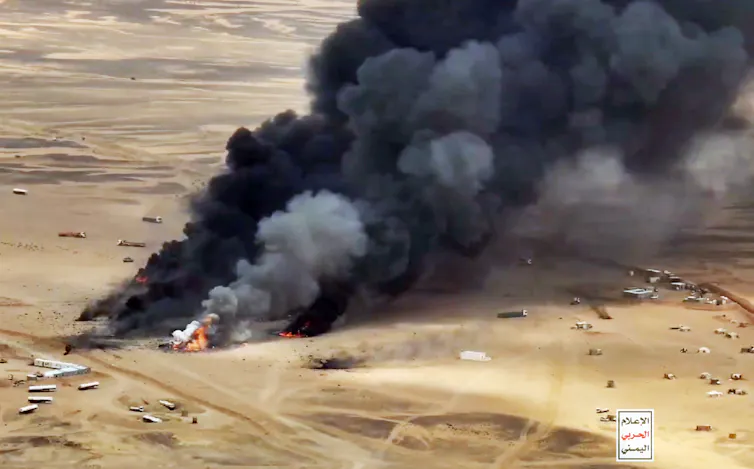
Houthi Media Center via Getty Images
What the Strait operation cannot buy
The seizure of the Bab el-Mandeb Strait and the ongoing fighting in the country come with serious risks for the Houthis, however. The leverage the Houthis are gaining vis-a-vis Saudi Arabia and on the battlefield in Yemen could come at the cost of their broader standing in Yemen.
No government or entity has ever managed to hold both military and political supremacy over the entire territory of Yemen in modern history. While the Houthis have achieved military supremacy in the vast majority of the northwest, they have never pursued anything resembling a political bargain with the internationally backed government or even other parties. Their movement has always prized military dominance over political inclusion.
The latest coastal offensive is no exception.
According to Houthi-affiliated news sources, within days of taking Mokha the group had moved to reopen the port’s customs house, cut port fees and customs duties by as much as half and launched a drive to hand out 20,000 food baskets across Mokha and the neighboring coastal districts, while its authority in Sanaa offered a general amnesty to the fighters who had held the coast against it. A week later, its leader, Abdulmalik al-Houthi, told southerners directly that his forces were not targeting them, only the troops Saudi Arabia had brought in.
That is legitimacy performed through governance after a military conquest, more public relations than policy. It certainly isn’t the political bargain that could hold Yemen together for long. Moreover, a decade of Houthi rule in Sanaa suggests that they have no desire to work with others. Their modus operandi has been to rule by guns, not coalition.
More broadly, seizing the Arabian Peninsula’s other choke point and banning Saudi shipping through it makes the Houthis look, to much of the world and no small part of Yemen, like Tehran’s instrument – whatever their own objectives actually are.
And it invites the Houthis’ enemies to respond with force, potentially weakening the group’s capabilities.
Saudi Arabia is not a neutral party waiting patiently for good sense to prevail. It has prosecuted the war in Yemen for over a decade at enormous cost to the country’s civilians. Few in Yemen expect the Saudi-backed government to try retaking Sanaa by force, and a negotiated settlement will most likely be necessary eventually. But the Houthis have certainly now exposed themselves – and any Yemeni civilians caught up in escalation – to relentless airstrikes by Saudi Arabia and its allies.
For the Houthis, the gamble to advance now may backfire. It is one thing to take territory and quite another thing to hold it. Moreover, the Houthis may now find themselves controlling a strait the world wants reopened while still lacking the one thing that strait was never going to buy them: a whole country that actually consents to their rule.