

Nearly every massive galaxy observed hosts a supermassive black hole at its center. NASA’s James Webb Space Telescope has discovered that some of these supermassive black holes may even be too big for the galaxy they’re found in, challenging astronomers’ understanding of these objects and prompting questions about their growth in the early universe. Astronomers are still investigating many key questions about these mysterious and powerful objects, and studying them can help researchers understand how galaxies form and grow.
I’m an astronomer who studies supermassive black holes in other galaxies. These fascinating astronomical objects can tell researchers about how matter gets consumed or expelled from the center of the galaxy and how that may affect other processes in the galaxy.
What are supermassive black holes?
Supermassive black holes are the largest class of black holes.
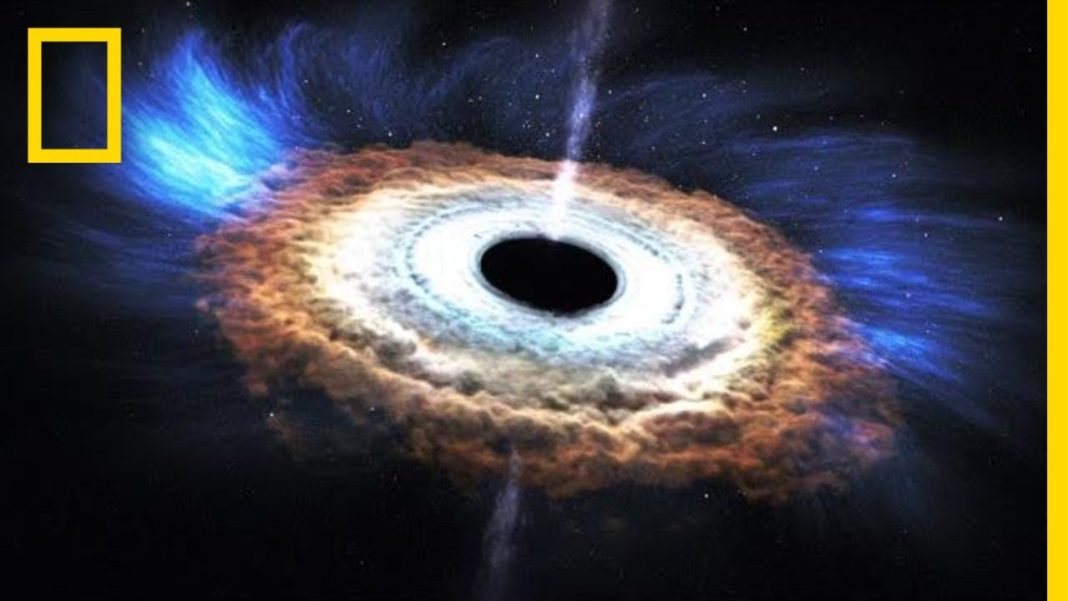
Black holes are regions in space in which gravity has become such a predominant force that nothing, not even light, can escape. These black holes range from hundreds of thousands to millions or billions of times more massive than our Sun.
Studies suggest that nearly every massive galaxy astronomers have observed has a supermassive black hole at the center. However, galaxies are so large that these black holes occupy only a small part, and they’re outweighed by gas, dust and stars.
A supermassive black hole is enclosed by its event horizon, or the point of no return. Any object that crosses the horizon would have to be traveling faster than the speed of light to escape the black hole, which is not physically possible.
If you were to place the supermassive black hole in the center of our galaxy, named Sagittarius A*, where the Sun would be, its event horizon and surrounding gas would fit within the orbit of Mercury. However, for a more massive supermassive black hole, such as M87*, the entirety of the solar system would fit within the event horizon.

Credit: EHT collaboration (acknowledgment: Lia Medeiros, xkcd)., CC BY
How do scientists study supermassive black holes?
Observationally, supermassive black holes are hard to catch.
Even though many are millions of times larger than our Sun, they occupy only a small part of a galaxy, which can be further enshrouded by stars and dust. To date, only two “images” have been taken of supermassive black holes, both by the Event Horizon Telescope Collaboration.
Because it is very difficult to take pictures directly, astronomers have to use indirect methods to learn about supermassive black holes and their properties.
To figure out the mass of a supermassive black hole, astronomers can look at its surrounding host galaxy and calculate the mass needed to exert that gravitational force on the components of the galaxy. Supermassive black holes that are consuming matter are categorized as active, whereas supermassive black holes that do not consume matter are known as inactive or quiescent.
For galaxies with a quiescent supermassive black hole, astronomers measure how quickly the stars tightly packed near the center of the galaxy are traveling. They take the average of all these speeds and use a relation known as the M-sigma relation to get a mass that matches with the average measured speed.
For galaxies with an active supermassive black hole, astronomers look at the light the gas around the event horizon emits. If scientists make the assumption that the gas is moving in an orbit around the supermassive black hole, the width of the surrounding gas corresponds to the central mass, and that can provide another way to estimate mass.
Astronomers can also get a sense of how much mass is falling into an active black hole by measuring the luminosity, or observed power, of the gas before it crosses the event horizon.
What don’t we know about these objects
Astronomers are also interested in figuring out how supermassive black holes form. While they already know how smaller black holes, called stellar mass black holes, form, supermassive black holes are too big to form in the same way.
Stellar mass black holes form when a massive star runs out of fuel. Gravity causes its core to collapse, which sends out a shock wave that destroys the star and can leave behind a black hole. However, the stars that form these stellar mass black holes are not large enough to form supermassive black holes.
Scientists have two hypotheses for the formation of supermassive black hole seeds. The seeds are the initial black holes that gain mass over time until they turn into the supermassive black holes that we observe today.
One hypothesis is that they are the results of massive, young stars in the early universe, known as Population III stars, dying. The other hypothesis theorizes supermassive black hole seeds came from a large gas cloud collapsing, due to its large mass and strong gravity, into a black hole.
Neither hypothesis currently has direct observational evidence supporting it, but results from the James Webb Space Telescope hope to answer these questions.

ESO, ESA/Hubble, M. Kornmesser/N. Bartmann, CC BY-NC
Another major question that has not been answered is when these supermassive black holes form.
This question becomes a bit of a chicken-or-the-egg problem: Did the supermassive black hole seeds form first, then gradually attract the matter that eventually formed the galaxy around it? Or did a galaxy start to coalesce first, and stars and gas clouds inside it collapsed into the supermassive black hole seeds?
Preliminary results and observations suggest the former is more likely, but if that’s the case, it raises the question: How could the rest of the galaxy form and evolve with the supermassive black hole inside it?
Why is it important to study them?
Supermassive black holes affect their host galaxies. As the supermassive black hole grows, astronomers see an increase in the speed of the stars located in the central cluster of the galaxy. This pattern suggests a link between the supermassive black hole and the other components of the galaxy, such as stars, gas and dust.
Often, scientists observe matter falling inward, toward the black hole. But before it’s sucked in, some of it gets blown back by winds created by the black hole’s intense pressure and friction. This matter blown away from the vicinity of the supermassive black hole may either heat up gas and prevent stars from forming or compress gas and cause shock waves within the galaxy.
Though a supermassive black hole can affect its host galaxy, Earth is in no danger of being sucked up or taken into the black hole at the Milky Way’s center. In most galaxies, the supermassive black hole simply acts as a gravitational force that keeps objects in the galaxy in orbit.
However, it is important for scientists to understand how supermassive black holes affect their host galaxies, and how they can shape our observations of the universe.