

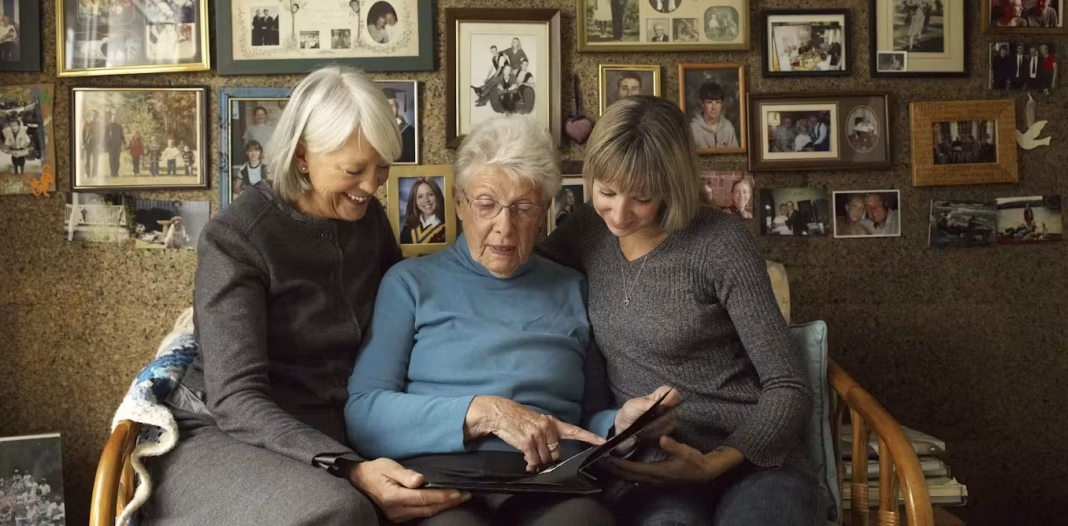

Old age and forgetfulness seem to go hand in hand. But my colleagues and I found that memories actually becomes less precise, not entirely forgotten. Our study, published in the journal Cerebral Cortex, shows how the brain blends related experiences as you age rather than replaying the exact one you need.
Memory is a complicated process. Even when everything’s working as it should, the way people remember specific events has many parts.
Say you have a conversation with a friend. The first stage of memory is when you’re experiencing, feeling and perceiving details of an event as it happens. The second stage involves storing these details in your brain’s file cabinet. The third stage covers when you need to search that file cabinet for just the right file when, a week later, you want to remember that conversation with your friend. This last retrieval stage is what many people think of as memory.
Imagine that when your brain was retrieving information from that conversation with your friend, it accidentally combined details from that conversation with one you had with your spouse that morning. When you then try to remember the conversation with your friend, you actually pull the file for the conversation with your spouse instead. This kind of mix-up might be an example of what happens with the aging brain.
Why it matters
Remembering people and events is important for many social activities. Confusing people’s names can be embarrassing. The fear of confusing memories can even lead to social isolation.
Scientists already know that confusing memories happens more often than forgetting them altogether. What’s less clear is how the brain gets confused.
My team’s study tried to understand when in the memory process these mix-ups happen and how the brain’s memory center, called the hippocampus, plays a role.
The hippocampus is involved in all stages of memory. The patterns of neural firing that occur during the first stage of memory – the initial experience of talking with your friend – often recur while your brain is filing that memory away and later when retrieving it.
For our study, we scanned the brains of young, middle-aged and older adults while they went through those same three stages of memory. While in the scanner, they briefly saw images of a face at the top of the screen and an image of either a scene or an object, such as a forest or an apple, on the bottom of the screen.
We told participants to imagine the person at the top interacting in the scene or with the object. Each image pair served as a separate “event.”
They then relaxed for 20 minutes while we continued to record their brain activity. Finally, they took a memory test in which a face they had previously seen reappeared on top with four images below. Participants had to remember which of those images had previously been paired with the face. We repeated this test several times to gauge how well people remembered links between faces and scenes and objects across events.
We found that older people had more memory mix-ups than young adults. For instance, they were more likely to falsely remember a face that was initially paired with an apple as having been paired with a forest. Older people were also less likely to repeat the same brain activity patterns seen when they first experienced, stored and retrieved a specific memory. Surprisingly, even when older adults did repeat the original brain patterns, they were even more likely to confuse their memories.
Our study provides new evidence that the hippocampus is inappropriately changing memories between different memory phases as one gets older.
What still isn’t known
Research in young adults, including those in our study, suggests that the hippocampus is supposed to engage in the same neural firing patterns when remembering an event as when first experiencing it.
But the older adults who made more memory mix-ups than younger participants showed these same neural patterns. So what is the brain signature when older adults get a memory right? Are other brain regions outside the hippocampus helping? We did not get a good answer for these questions from our study.
What’s next
Researchers are still learning how different brain regions talk to one another. One of the next frontiers in neuroscience is understanding how electrically stimulating the hippocampus prevents memory loss or restores lost memories.
Future interventions might try to strengthen the hippocampus to prevent it from changing a memory after it’s stored. Researchers already have some ideas for this: intensive exercise, mindfulness training, brain stimulation and even recording memory cues on smartphones.
But researchers still need to investigate whether changing the hippocampus can lead to stable, consistent memories over time.
The Research Brief is a short take about interesting academic work.



