



A new White House report argues that eight decades of science policy that helped make the United States the world’s scientific leader is too bureaucratic, too focused on institutions rather than individual researchers, and too slow to translate discoveries into economic and technological advantages.
Supporters see it as a needed modernization of American science policy. Others argue that it places insufficient emphasis on the universities, laboratories and federal agencies that enable and sustain U.S. scientific leadership.
Research affects health, prosperity, quality of life and national security. The technologies that shape modern life, from GPS navigation and weather forecasting to cancer therapies and cellular communications, all rely on scientific discovery.
The debate raises a broader question: What created American scientific leadership in the first place, and what will be required to sustain it?
H. Christopher Frey
US didn’t become a scientific leader by accident
During World War II, Vannevar Bush, who coordinated much of the nation’s wartime research effort, led federal programs that created new technologies such as radar and mass-produced penicillin. In 1944, President Franklin Roosevelt asked Bush to develop a blueprint for how science could contribute to national health, economic prosperity and job creation after the war.
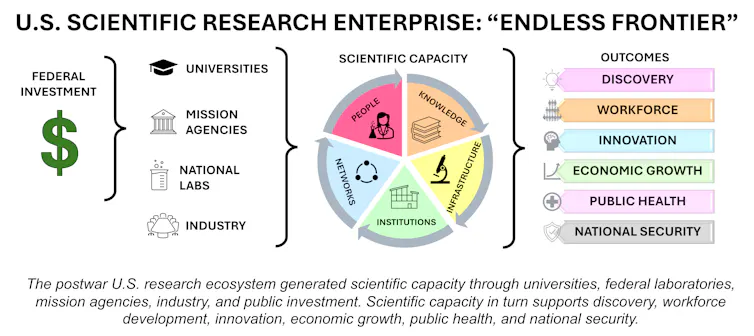
Bush’s 1945 report, Science: The Endless Frontier, established a framework in which government, universities and industry played complementary roles. The federal government would invest in research and scientific talent. Universities would perform research while educating future scientists and engineers. Industry would transform discoveries into products and services.
The model worked.
The postwar research system laid the foundation for innovations ranging from microelectronics and biotechnology to the internet. Its success can be measured not only in discoveries but also in outcomes: scientific leadership, a highly skilled workforce, innovation clusters of new firms centered on universities that discover new knowledge via research, jobs and long-term economic growth.
The United States did not become a scientific superpower by chance. It built institutions that repeatedly generated both new knowledge and new talent.

AP Photo/John McDonnell
Why rethink the system now?
The Trump administration’s July 2026 report, Science: A New Golden Age, argues that American science policy requires significant reform.
Having spent much of my career at the intersection of scientific research, research management and science policy, I believe that the report raises several important issues that deserve attention. Administrative burden on researchers is real. Technology transfer could be improved. Artificial intelligence is transforming research and innovation. China’s rise as a scientific and technological competitor presents a genuine strategic challenge.
At the same time, the report arrives after a series of Trump administration policy actions that have already begun reshaping universities, federal agencies and federal research funding. The debate is therefore not simply about a future vision. It is also about how current policy changes may reshape the American research enterprise for decades to come.
What the new vision misses
The report places heavy emphasis on innovation, commercialization and technology deployment. What receives less attention is how the capacity for future innovation is created and sustained.
Long-term innovation emerges not from isolated projects but from ecosystems in which universities, government laboratories, federal agencies and industry play distinct but mutually reinforcing roles. Many of today’s technologies exist because these institutions invested for decades in ideas that initially had no obvious commercial value.
Moreover, universities and federal agencies do far more than conduct research.
Universities educate the next generation of scientists, engineers and entrepreneurs. They maintain specialized infrastructure, generate new knowledge and support scientific communities that accelerate discovery. Their unique contribution is that they simultaneously create knowledge and develop the workforce that puts knowledge to use.

NOAA Photo Library/Flickr
Federal mission agencies, including the Centers for Disease Control and Prevention, Department of Energy, Environmental Protection Agency, National Institute of Standards and Technology, National Oceanic and Atmospheric Administration, U.S. Department of Agriculture and U.S. Geological Survey, play different but equally important roles. They conduct and support science that informs decisions affecting public health, environmental protection, energy security, economic development and public safety. Many of these activities generate public benefits that market forces alone are unlikely to adequately provide.
Scientific capacity takes decades to build
Scientific leadership depends on people, institutions, infrastructure and knowledge. These assets accumulate slowly over decades but can be weakened surprisingly quickly.
The current debate is not merely theoretical. Funding reductions, workforce losses and disruptions affecting universities and federal agencies are already reshaping parts of the American research enterprise.
Advocates of these changes argue that resources should be redirected toward faster innovation and greater efficiency. Critics worry that weakening institutions responsible for discovery, workforce development and mission-oriented science will reduce the nation’s long-term capacity to innovate.
Innovation is essential, but it ultimately depends on a continuing supply of new ideas, talented people and organizations capable of sustaining long-term research. Discovery and innovation are not competing priorities. They depend on each other.

AP/Business Wire
America’s competitors understand this balance
Perhaps the strongest endorsement of the postwar American model is the adoption of its core features by international competitors.
China has invested heavily in research universities, scientific workforce development, research infrastructure and technology clusters that connect universities, government laboratories and industry. In several areas of science and technology, China is now rivaling or surpassing the United States.
Scientific competition increasingly involves competition among research ecosystems rather than competition over individual technologies.
A nation that underinvests in scientific capacity while its competitors expand theirs risks losing advantages that took generations to build.
What a genuine new golden age would require
A true golden age of American science would not simply preserve the status quo. Administrative burden could be reduced. Technology transfer can be improved. New institutional models deserve experimentation.
If the goal is to sustain U.S. scientific leadership, though, efforts to modernize the research system should strengthen rather than weaken the institutions that produced that leadership. The White House report does not establish federal policy on its own, but it signals how the administration views the relative importance of innovation, technology deployment, universities, federal agencies and industry within the research ecosystem.
Universities remain essential for discovery, workforce development and scientific infrastructure. Federal agencies continue to generate science that directly benefits society through better public decisions. Industry remains indispensable for transforming discoveries into products and services. The challenge is not choosing among these institutions, but ensuring that they remain mutually reinforcing parts of a larger innovation ecosystem.
A genuine new golden age will require innovation, while also sustaining the institutions that generate innovation in the first place.