


NASA’s plans to return astronauts to the Moon through the Artemis program and ultimately send humans to Mars highlight just how far space exploration has come. Yet while the Moon and Mars remain compelling destinations filled with scientific mysteries, looking beyond our solar system raises even deeper questions about the universe itself.
Among the biggest of those mysteries is matter – the substance that makes up everything around us. Surprisingly, most of the matter in the universe is invisible, and astronomers still do not know what it is.
Physicists estimate that about 85% of all matter is made of something we cannot see, touch or directly detect. This elusive substance is known as dark matter. It doesn’t emit light like stars or galaxies. The only reason scientists know it exists is because of its gravity.
Galaxies rotate too fast to be held together by just the matter that can be seen. Light bends more strongly than expected as it travels through space. Galaxies within clusters fly past one another much faster than they should based on their visible mass alone.
Based on data from across the cosmos, scientists keep coming to the same conclusion: There is something out there that cannot be seen, but whose presence is unmistakable. It’s a question that has intrigued astronomers like us for more than 50 years.
So what is dark matter, and why does it matter?
A missing piece of the cosmic puzzle
Everything in our everyday world is made of atoms, which are combinations of protons, neutrons and electrons. These particles form stars, planets, people and everything you see.
Dark matter, scientists believe, is fundamentally different. It is likely made of entirely new kinds of particles yet to be discovered. Understanding what those particles are would fill a major gap in the scientific understanding of physics. But the importance of dark matter goes far beyond particle physics.
Dark matter played a crucial role in shaping the universe. Shortly after the Big Bang that kicked off the birth of the universe, it acted as a kind of gravitational scaffolding, helping ordinary matter clump together to form the first galaxies and stars. Even today, it acts as the invisible glue that holds galaxies together.
In other words, without dark matter, the universe as you know it might not exist.
Looking for invisible matter
Because dark matter does not emit light, scientists must search for it indirectly. One promising approach is to look for the signals it might produce when its particles collide and destroy each other through a process known as annihilation.
This idea may sound exotic, but it has a familiar analogy. In medical imaging, devices such as positron emission tomography scanners, or PET scanners for short, detect radiation produced when particles of antimatter – positrons – annihilate with electrons, which are normal matter.
Antimatter is just a form of matter made of particles that have the same mass as ordinary matter, but opposite charges and quantum properties. The annihilation signals in PET scanners allow doctors to map cancerous tissues inside the human body.
Scientists hope something similar could happen with dark matter. If dark matter particles annihilate with each other, they may produce high-energy radiation called gamma rays. These gamma rays could act as fingerprints, revealing where dark matter is concentrated and its properties.
As astrophysicists who study gamma rays, we and our collaborators use space-based telescopes to search for these signals.

Volker Springel/Virgo Consortium, The Aquarius Project
A mysterious signal at the heart of our galaxy
One of the most powerful tools for this search is NASA’s Fermi Large Area Telescope, known as Fermi-LAT, which has been observing the gamma-ray sky since 2008. Gamma rays are the most energetic form of light, and they are produced by some of the universe’s most extreme phenomena.
For years, Fermi has detected an unexplained glow of gamma rays coming from the center of the Milky Way. Based on gravitational observations such as galaxy rotation curves, stellar motions, and the bending of light, combined with cosmological simulations, astrophysicists expect this region to be extremely rich in dark matter, making it an intriguing place to look for annihilation signals.
Could this glow be evidence of dark matter?
Possibly. But there’s a complication: The center of our galaxy is also crowded with more conventional astrophysical gamma ray sources, such as rapidly spinning neutron stars, which are produced from the collapse of massive stars. These objects can produce gamma rays that mimic the expected signal from dark matter.
At the moment, scientists cannot say for certain what is causing the emission. The signal could be a breakthrough, or it could be something more ordinary.
Clues from smaller galaxies
To help resolve this mystery, researchers also study much smaller systems, known as dwarf galaxies, which orbit the Milky Way. These galaxies contain dark matter but relatively few other sources of gamma rays, making them cleaner environments to search for dark matter-related signals.
So far, no definitive detection has been made.
However, an analysis published in March 2024 led by our team at Clemson University found hints of a signal emerging from these dwarf galaxies, and updated results collected since have supported these findings.
Using the latest Fermi-LAT data, combined with an updated census of dwarf galaxies and improved estimates of their dark matter content, we searched for faint gamma-ray signals across the population of dwarf galaxies. This led us to uncover an excess of gamma rays that earlier studies had also hinted at. The more data we’ve collected, the more significant the excess appears to become.
The evidence is not yet strong enough to claim a detection of dark matter, but it is intriguing. The properties of this signal are also consistent with what scientists see in the center of the Milky Way. If both signals share the same origin, the case for dark matter would grow stronger.

NASA’s Goddard Space Flight Center/Chris Smith (USRA/GESTAR)
The next decade could be decisive
Confirming a dark matter signal will require more data and better instruments working together.
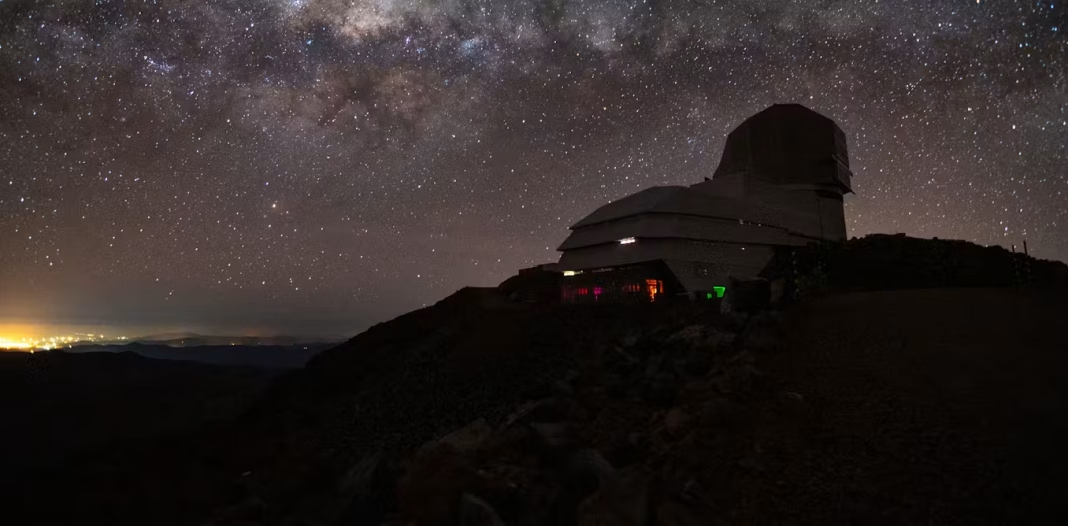
Future observations from the Fermi-LAT will continue to improve the sensitivity of these searches. Additionally, new facilities such as the Vera C. Rubin Observatory in Chile, are expected to discover more dwarf galaxies for researchers to study.
Another key mission is NASA’s Compton Spectrometer and Imager, or COSI, scheduled for launch in 2027. COSI will offer a new view of the gamma-ray sky and could help clear up several longstanding mysteries. Among these mysteries is yet another unexplained bright glow from the center of the galaxy, produced when electrons and positrons annihilate, just as in PET scans.

COSI artist’s concept, above — Northrop Grumman Systems Corporation
Despite discovering the annihilation signal more than 50 years ago, scientists still don’t know where these positrons are coming from. By mapping this emission in unprecedented detail, COSI could help reveal what’s producing the glow, and whether it might be connected to dark matter and other unexplained signals in the Milky Way.
These efforts, along with many other ongoing searches, may help determine whether scientists are truly seeing the fingerprints of dark matter or something else entirely.
As humans push further into space, from the Moon to Mars and beyond, new worlds wait to be discovered. In parallel with the new age of space exploration, with each new observation, scientists may be getting closer to answering one of the most fundamental questions in physics.