



For decades after the Cuban Revolution’s victory in 1959, influential anticommunist circles in the United States claimed that Cuba’s communist government sowed social division and allied with left-wing groups to help defeat Washington during the Cold War.
This right-wing rhetoric has been revived in the Trump State Department’s July 20, 2026, report, “Cuba: The Capital of 21st Century Communism.” In it, the administration seizes on the history of a movement called the Tricontinental – an alliance of liberation movements from around the world founded in 1966 – to make the unsubstantiated claim that the U.S. left is currently engaged in a Cuban conspiracy to destroy the U.S.
As a professor of Latin American studies at the University of Virginia, I wrote the first scholarly book on the Tricontinental movement, “From the Tricontinental to the Global South: Race, Radicalism, and Transnational Solidarity.”
The State Department’s report summarizes large portions of that book’s arguments without citation, particularly in its attention to the Tricontinental’s historical relationship with the U.S. Civil Rights Movement. The report also misrepresents a larger body of scholarship on the relationship between Cuba and the left wing in the U.S. The State Department didn’t respond to a request for comment on whether it had used my book as a source.
But while the report preserves the structure of my book’s historical arguments, it twists its interpretations and conclusions. The effect is to support the Trump administration’s false claim that Cuba has “backed an unprecedented wave of left-wing terrorism on American soil.”
Victoria and Albert Museum, London.
The birth of a movement
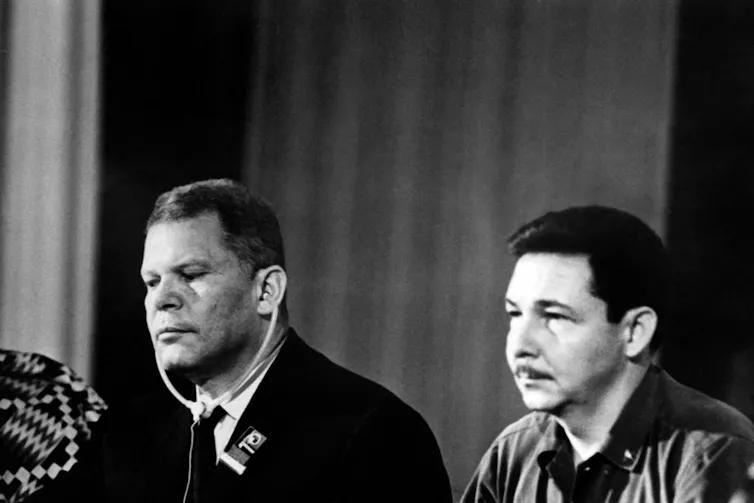
The Tricontinental was officially known as the Organization of Solidarity with the Peoples of Africa, Asia, and Latin America, or OSPAAAL. It was formed in 1966 when self-determination movements from 82 countries came together in Havana for the Tricontinental Conference. Although some conference delegates were recognizable leaders of political parties – like Chile’s Salvador Allende and Guinea-Bissau’s Amílcar Cabral – most were lesser-known representatives of a variety of political organizations, including from the United States.
The OSPAAAL formed as the expansion into the Americas of the Afro-Asian Peoples’ Solidarity Organization (AAPSO), founded in 1957 as an alternative power bloc to the U.S.-Soviet Cold War division. Seeking new global allies, Cuba joined the Afro-Asian bloc after Havana’s 1962 ousting from the Organization of American States. With Cuba’s joining of AAPSO to form OSPAAAL, leftist organizations and political figures from across Latin America and the U.S. also joined as members.
AFP via Getty Images
Yet the history of the Tricontinental had much deeper roots in Black political movements in the Americas. The original idea for the Tricontinental came from Afro-Cuban intellectual Walterio Carbonell, who had close links to trans-Atlantic Black activist networks. In the Tricontinental’s aim to bring together class- and race-based organizing, it responded to long-standing debates within those networks.
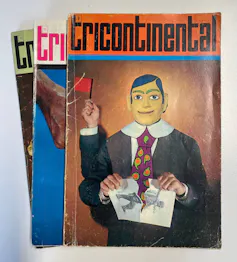
More than a conference or an alliance, the Tricontinental movement should be understood as a producer of political culture. For over four decades and in multiple languages, it distributed magazines, films, posters and other materials around the world. The Tricontinental became known for the artistically innovative films, posters and magazines that it published in English, Spanish, French and Arabic.
The OSPAAAL created a shared language and aesthetics for a wide range of anticolonial and anti-racist movements worldwide. Through its materials, the OSPAAAL played a pivotal role in generating international solidarity with the U.S. Civil Rights Movement as well as with the anti-apartheid struggle in South Africa. Black activists from the U.S., moreover, helped shape its vision.
Although the OSPAAAL continued to produce materials until its 2019 closure, it reached its peak in the 1960s and ‘70s and is primarily known today for its striking posters.
A critique of US policy, not people
The Tricontinental movement was not a tool used by Cuba to “express hatred of the United States,” as argued by the Trump administration’s Cuba report. Instead, it differentiated its critique of the U.S. government’s military interventions in Vietnam or Cuba from its abiding support for the American people.
Tricontinental magazine and Tricontinental Bulletin often featured U.S. civil rights leaders and organizations and demonstrated a commitment to solidarity with the struggles of U.S. citizens to gain full rights and freedom.
Moreover, the OSPAAAL was an international, nongovernmental organization that did not belong solely to Cuba. Although Cuba played a central role in its operations, Tricontinental materials reflected a variety of leftist positions that did not always align perfectly with the Cuban government’s rhetoric.
And although the OSPAAAL was highly critical of U.S. military interventions in Latin America and elsewhere, its critique was not exclusively focused on the U.S.
To address the concerns of its diverse membership, the OSPAAAL defined its global enemy of “imperialism” broadly, encompassing forces of exploitation suffered by all members. For its membership, that included notions of settler colonialism, such as in land that became Israel and the occupied Palestinian territories; exploitation colonialism, such as in the former Portuguese colonies in Africa; and strategies of economic domination that characterized U.S. policy toward Latin America and similar trends elsewhere.
AP Photo
Cuba and beyond
Activists involved in the OSPAAAL also had varied positions toward Cuba’s communist government.
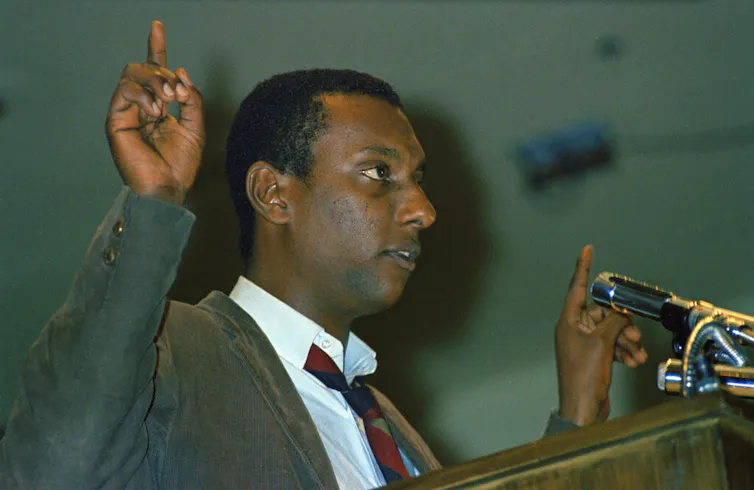
The Black Power activist Stokely Carmichael, who was invited to become a member of the OSPAAAL’s executive secretariat, developed a critical stance against the Cuban government’s restrictions on anti-racist political organizing within Cuba based on its claim that socialist reforms had ended structural racial inequalities on the island.
The North Carolina NAACP activist Robert F. Williams, who attended the Tricontinental Conference, developed similar viewpoints after living in Cuba from 1961-1965. While these activists eventually distanced themselves from the Cuban government, they continued to underscore the core tenets of the politics of Tricontinentalism in their writings.
The history of these Tricontinental activists is increasingly relevant today. For people like Carmichael or Williams, who devoted their lives to the struggle for freedom for all people, support for Cuban self-determination also required a critical engagement with the flaws of its government.
The White House Cuba report exemplifies the false binaries that predominate in discussions about Cuba on both the left and right.
The report falsely suggests that any group opposed to American intervention in Cuba is an imminent threat to the United States. Alternatively, due to the U.S. government’s long-term efforts to punish Cuba through economic embargo and attempted regime change, some sectors of the U.S. left view any criticism of Cuba’s government as an attack on its sovereignty.
The Tricontinental’s history offers a more nuanced and principled political position, one that opposes oppression in any form and that places self-determination for all people at the heart of its politics. The Trump administration’s use of that history for today’s policy toward Cuba is, I believe, mere political theater.