


If you’ve ever felt overwhelmed by menu options at a restaurant, cereal varieties at the grocery store or potential partners while scrolling through dating apps, you’ve experienced choice overload.
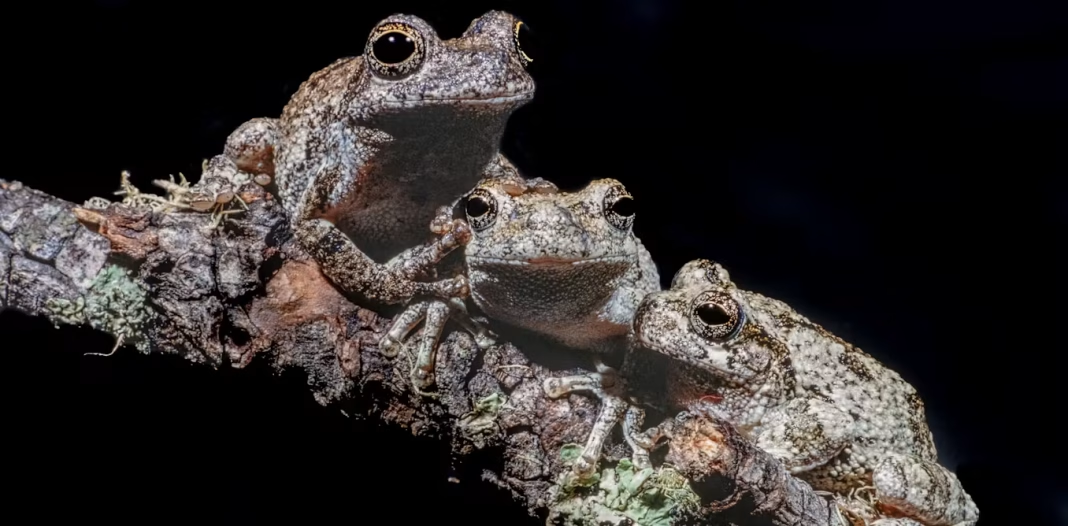
People aren’t the only ones to have trouble making decisions when confronted with many options simultaneously. In our new study published in the journal iScience, my colleagues and I found similar effects of choice overload in female gray tree frogs when faced with too many calls from males looking for love.
Scientists have observed many species having similar decision-making problems when experiencing choice overload. But we know little about how these kinds of cognitive constraints affect animals in natural settings.
Indecision on the frog dating scene
The gray tree frogs we focused on live in wooded areas near sources of water in North America. During the mating season, males gather in choruses and call to attract mates. Females pick mates based on several call attributes, including call length. Longer calls are more attractive.
Jessie Tanner1.43 MB (download)
For our experiment, we captured 60 female tree frogs from breeding choruses in East Tennessee and brought them into our lab. Then we played recorded mating calls for each female, giving her a choice between one long, attractive “target” call and one, three or seven shorter, less attractive “distractor” calls.
In the wild, a tree frog breeding chorus can include dozens or even hundreds of calling males. In our lab setup, the calls played sequentially, so they never overlapped.
Females would hop toward the speaker broadcasting the call she preferred. As the number of distractor calls increased, females got worse at picking the attractive call, took longer to decide, and were more likely to defer choosing within the 10-minute window altogether.

Jessie Tanner
Cognitive confusion
Because we eliminated call overlap entirely, we know this decline wasn’t due to what researchers call energetic masking. That’s the well-documented problem of overlapping signals impairing an individual’s ability to detect and discriminate a signal from noise.
Biologists have long known that female preferences can weaken in choruses and have usually assumed the explanation is energetic masking: Too many overlapping signals create a challenge for the frogs’ perceptual systems. In other words, they can’t detect or discriminate individual calls.
Instead, our study shows that a female’s own cognitive limits can make it hard for her to select her preferred mate. The challenge comes from too many males to choose from, not being unable to hear the males clearly.
When females can’t make the optimal choice
Call traits are linked to offspring fitness in gray tree frogs. If females have trouble recognizing the calls they prefer in a real chorus, they aren’t able to pick the mates with the best genes to pass on. They may end up mating with males they would otherwise reject. These males with less going for them then pass on their less desirable traits, which could have negative consequences for the offspring.

Jessie Tanner
Our finding raises the possibility that males could exploit this cognitive limitation in females. Less attractive males might do better by joining bigger choruses, where the sheer number of competitors makes it harder for females to discriminate against them. Conversely, more attractive males may benefit from calling in smaller groups, or even in isolation. My colleagues and I hope to investigate some of these possibilities soon.
More options, more opportunities … to a point
We ran our experiments in a simplified lab arena, which allowed us to isolate choice overload from other effects. We removed the real-world clutter of overlapping calls, vegetation and risk from predators that females would face in an actual pond. We also limited female choice to eight calls, though frogs may hear even more in natural settings.
The next step in this research is figuring out how much choice overload matters in a real chorus, where calls do overlap, and where sensory processing and cognitive processing are probably both at play. We’re particularly interested in seeing whether, in natural choruses, decisions do take longer and females really end up mating with less preferable males.
Choice overload isn’t unique to frogs, or even to mate choice. Researchers have seen bees choosing among flowers, ants comparing potential nest sites and mosquitoes selecting egg-laying sites all making worse decisions as the number of competing options increases. And recent research on field crickets and tree frogs has found similar patterns in these animals as they pick mates based on their calls.
Together, this growing body of evidence suggests that cognitive constraints are a general feature of animal decision-making.