

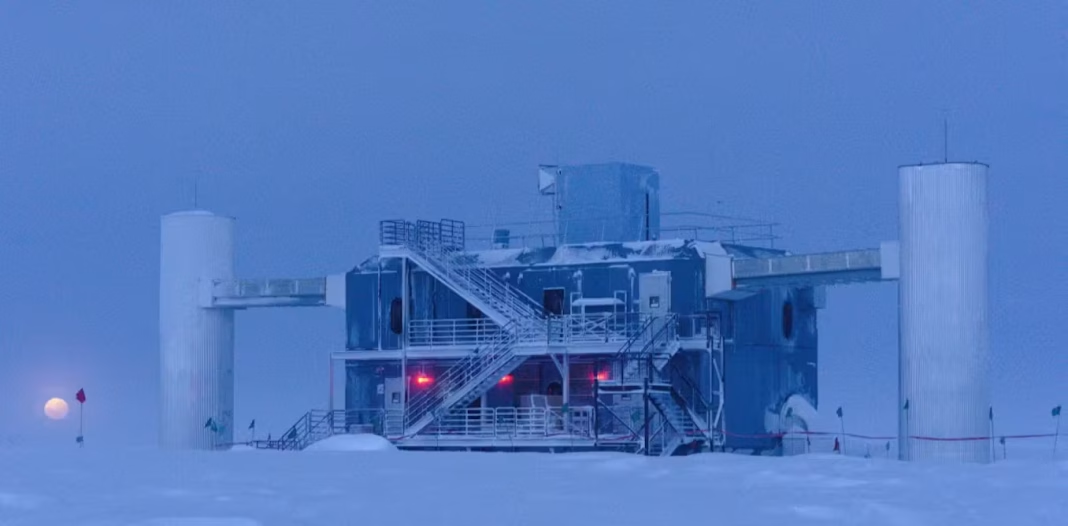

When Belgian American particle physicist Francis Halzen was awarded the 2026 Nobel Prize in physics “for decisive contributions to the IceCube Neutrino Observatory and the discovery of high-energy neutrinos of astrophysical origin,” it was a reminder that for more than a century, scientists have treated Antarctica’s environments as windows onto worlds beyond Earth.
Antarctica has offered scientists a means of reaching and researching beyond Earth without leaving it. Various harsh and challenging Antarctic environments have served as testing sites for equipment destined for the Moon, Mars and beyond. Its ice has collected meteorites that arrive from extraterrestrial sources. And it is one of the best places on Earth from which to observe the universe.
Antarctica as an extraterrestrial-type place
Since the start of the 20th century, scientists have drawn parallels between Antarctic environments and those that can be found beyond our planet.
In 1901, the Australian physicist Louis Bernacchi compared being in Antarctica to what he thought it would be like on the Moon: “a dead silent world above you, and a dead silent world at your feet.”
By the mid-20th century, Antarctic environments were frequently used as approximations of extraterrestrial worlds. NASA officials traveled to the Antarctic “because this was as close to lunar conditions as we could get here on Earth,” as one of them, Ernst Stuhlinger, put it in 1968.
In preparation for the Viking mission to Mars in 1975-76, several microbiologists conducted research in the McMurdo Dry Valleys, convinced that this region of Antarctica closely resembled Mars. This type of research continues today.

NASA/JPL
Scientists continue to test technologies created for space exploration in the Antarctic, including spacesuits, robotics, and food production facilities, hoping that success in the Antarctic environment will translate into success in the more extreme environments of space.
Likewise, Antarctic workers have been studied to learn about the psychological aspects of long-term isolation and small-group dynamics in stressful situations, another key aspect of space exploration. The Outer Space Treaty of 1967 was even modeled after the 1959 Antarctic Treaty, agreeing among nations how to share special spaces for scientific research.
While some critics have said Antarctica’s conditions are too different to serve as a terrestrial stand-in for outer space, the idea of Antarctica as a practice or training ground for space exploration remains a fertile ground for the imagination, both for scientists and the general public.
Ice sheets and meteorites

Australian Antarctic Program
Antarctic meteorites offer scientists access to materials from the Moon, Mars and beyond without leaving Earth. The men of the 1911-1914 Australasian Antarctic Expedition, led by geologist Douglas Mawson, collected the first meteorite discovered in Antarctica.
Modern meteorite science in Antarctica can be dated to the 1970s, following the 10th Japanese Antarctic Research Expedition’s 1969 discovery of nine meteorites in the Yamato Mountains.
Meteorites come down all around the planet, but Antarctica’s blue-ice areas, which comprise about 1% of Antarctica’s surface ice, often in mountainous regions, are among the best places to look. In those areas, strong katabatic winds flowing fast downhill remove snow, exposing hard, translucent ice. Dark-colored meteorites are easily spotted in contrast with the light-blue ice. And blue-ice areas contain unusually high concentrations of meteorites, as rocks from outer space either land on the surface or emerge from within the ice after being transported by glacial movement.

NASA
In 1976, geologist William Cassidy established the United States’ formal efforts to search for meteorites in Antarctica. Geologist Ursula Marvin, a member of one of the program’s earliest expeditions, credited Antarctic environments with providing a special look at planetary geology: “While waiting for future space missions we have found an elegant means of significantly extending the range of planetary samples by making our yearly expeditions to Antarctica.”
That effort has yielded, for example, the first recognized meteorite from the Moon, as well as a meteorite from Mars, which sparked a media firestorm in the mid-1990s when some scientists suggested that it bore evidence of fossilized microbial life.

Argonne National Laboratory
High summits and clear skies
Despite one early physicist complaining that “taking Astronomical observations” in Antarctica’s weather was “positively painful,” astronomical work has been conducted in Antarctica for over a century. The central regions of the Antarctic ice sheet have low winds, long winter darkness and an exceptionally clear, stable atmosphere. Those conditions give Earth-based instruments unusually favorable access to signals coming from the cosmos.
Since the 1990s, the continent has been a major center for astronomy research, hosting a wide range of sensors and telescopes.
In 2007, the U.S. began operating the South Pole Telescope, which measures cosmic microwave background radiation and the dark energy driving the acceleration of the expansion of the universe, and which helped make the first image of a black hole in 2019. In subsequent years, research stations operated by Japan, China, France and Italy have also constructed increasingly large optical telescopes to observe astronomical objects, including stars and planets.
Scientists also use a constellation of other instruments on the Antarctic Plateau, such as the Antarctic PENGUIn magnetometer array, initially installed in the 1990s, to study extreme space weather events and advance understanding of the near-Earth space environment.
Closer to the coast, Antarctica also hosts a suite of other astrophysical research programs, such as the long-running “CosRay” observatory. Starting in 1960 at McMurdo, a neutron monitor measured low-energy cosmic rays – charged particles from outside the solar system. The project is still running, having moved to a nearby South Korean station in 2017.
IceCube and the Nobel Prize
Based at the University of Wisconsin, IceCube is a major international collaborative project that involves “450 physicists from 58 institutions in 14 countries,” its website reports.
The project began in 1987 when Halzen conceived of the Antarctic Muon and Neutrino Detector Array, known as AMANDA. That project tested the ability to use the ice of the polar plateau as a key element of a telescope to see neutrinos. Those elementary particles, first detected experimentally in 1956, travel through space, interacting only rarely with electrons and atomic nuclei.

IceCube
Constructed at the Amundsen-Scott South Pole Station starting in 1993, AMANDA was made up of 677 optical sensors deployed on 19 strings embedded deep in the polar ice. The strings were installed by drilling holes with hot water, lowering the modules into the ice and allowing the holes to refreeze.
The sensors wait for these rare occasions when a neutrino collides with a proton or neutron and produces charged particles that emit a faint flash, known as Cherenkov radiation. After AMANDA successfully detected neutrinos, Halzen and others in 2001 made the case to expand the array to place sensors throughout roughly a cubic kilometer of the Antarctic ice sheet. That project, IceCube, was originally deployed between 2004 and 2011, funded largely by the National Science Foundation.
With the larger group of sensors, scientists can not only detect neutrinos, but they can also determine their direction, energy and type. This allows them to trace some neutrinos back to their sources far away in the universe.
IceCube helps scientists gain insights into questions regarding supernova events, galaxy formation, the Big Bang, dark matter and the properties of the neutrino itself.
As Halzen and countless other scientists have found over the years, Antarctica’s extreme conditions serve as a crucial gateway to understanding some of the greatest mysteries of the cosmos.



