



When Luiz Inácio Lula da Silva addressed the United Nations General Assembly on Sept. 22, 2026, the Brazilian president posed a question to both an international and domestic audience: Who is to decide Brazil’s future?
It is an unusually pressing question this year. Voters in Latin America’s largest nation head to the polls on Oct. 4, marking the culmination of a campaign defined by a greater degree of U.S. interference than any election in recent memory. Although President Donald Trump has established a surprising personal rapport with the left-wing elder statesman, the U.S. administration doesn’t hide its preference for Flávio Bolsonaro. He is the son of the disgraced former President Jair Bolsonaro, who is currently serving a lengthy sentence after being convicted of attempting to overturn the results of the 2022 election.
Lula has responded to U.S. pressure – which has included tariffs, sanction threats and revoked visas – by making sovereignty a central theme of his campaign, arguing that Brazil’s political destiny must be set by Brazilians rather than what he sees as a capricious foreign power.
Lula’s language has been uncompromising and often colorful. At a campaign rally outside the capital, Brasília, on Sept. 16, Lula declared Brazil would not tolerate politicians who “by day display the national flag and at night get on all fours for the United States.”
He has denounced members of the Bolsonaro family as traitors conspiring against the national interest in pursuit of personal gain. Such rhetoric has contributed to Lula’s small but steady lead in most polls.
The underlying argument predates the current confrontation with Washington — and it’s also older than Lula himself, who would be sworn in at the age of 81 should he prevail in the national vote. Nationalism today might be “the master concept of the radical right,” as one scholar of extremism has put it, but it has never belonged exclusively to reactionaries in Brazil.
Dueling notions of the nation
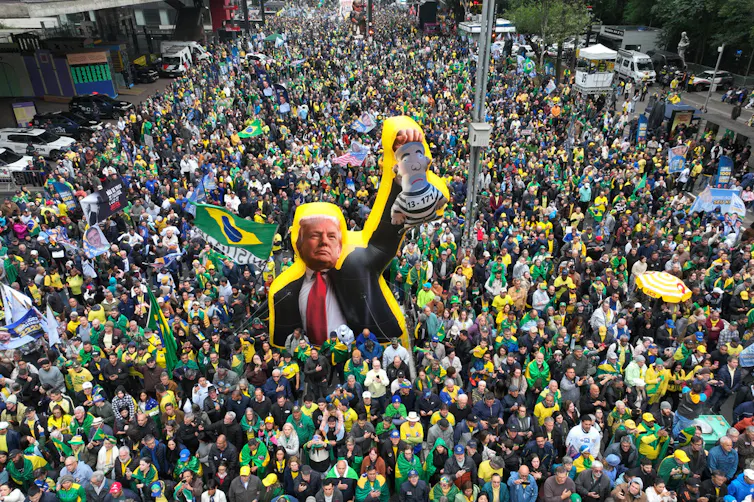
As I document in my new book, “Claiming the Nation,” Brazilian political movements both left and right throughout the 20th century competed to claim the nationalist mantle. In so doing, they argued about who was best positioned to ensure the nation lived up to its extraordinary natural potential while ascribing very different meanings to concepts like sovereignty and the national interest.
One of these political traditions – which can broadly be grouped as progressive nationalist – understood national sovereignty as the capacity to determine Brazil’s economic and political development on its own terms. For its proponents, a country could not be fully independent while its resources and institutions remained excessively dependent on decisions made elsewhere.
AP Photo/Andre Penner
A more conservative opposing strain of nationalism emerged after World War II in response to Brazil’s first era of mass democratic politics and presented Brazil’s failures less as a consequence of foreign dependence than of its own populist political class. This tradition viewed progressive nationalism as using promises of reform and demagogic tirades against scapegoats abroad to distract from their own corruption and irresponsibility.
These two nationalist traditions offered starkly different diagnoses of Brazil’s problems and divergent political prescriptions.
While Lula’s current appeals to sovereignty belong to the progressive tradition, they should not be mistaken for anti-Americanism. Brazil’s progressive nationalists have historically sought greater room for maneuver in the international system precisely because they understood national autonomy to depend on the ability to engage the world without becoming subordinate to any single power.
In that vein, Brazil has cultivated relations across ideological divides while seeking a larger voice in shaping the international order. Its efforts to assert that role, whether by pursuing a permanent seat on the U.N. Security Council or offering to mediate seemingly intractable geopolitical disputes, have often been dismissed as naive or misguided. As one commentator put it: “To behave as though Brazil could wield global power comparable to China’s, or even India’s, is pure folly.”
Yet such dismissals overlook the foreign-policy ambitions of a large and complex nation that has historically aspired to an important global role. Sovereignty, in this formulation, is less a demand for withdrawal than a claim to political agency.
The Bolsonaro reaction
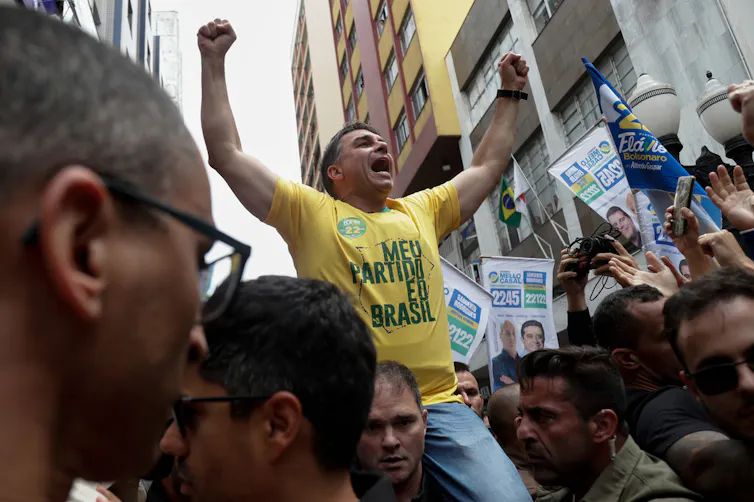
Flávio Bolsonaro, by contrast, criticizes Brazilian democratic institutions – particularly the Supreme Court and the electoral system – as obstacles to restoring the country’s political order.
AP Photo/Bruna Prado
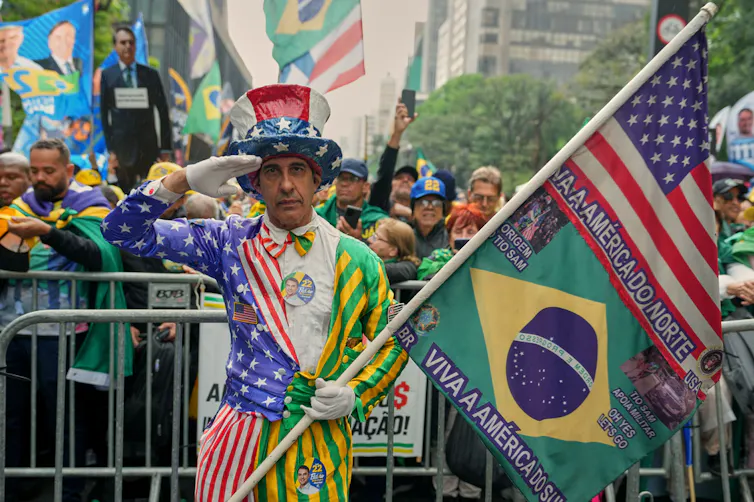
From this perspective, a closer relationship with the U.S. is perfectly compatible with national renewal. If sovereignty for Lula means defending Brazil’s freedom to chart its own course in the world, for Bolsonaristas it means reclaiming Brazil from the domestic forces he and his supporters blame for its decline.
Flávio Bolsonaro’s main target is the judiciary that prosecuted and ultimately imprisoned his father. His promise to free Jair Bolsonaro is presented not as a rejection of the rule of law but as part of a broader pledge to reform institutions that, in his telling, have exceeded their proper authority.
The irony is that, notwithstanding his nationalist posturing, a Flávio Bolsonaro electoral victory would strengthen the transnational far-right current that many critics see Trump as embodying, extending the reach of a political project deeply hostile to popular sovereignty abroad.
Brasília by way of New York
In his U.N. speech, Lula insisted that powerful countries cannot dictate the political choices of weaker ones. That message comes weeks after a leaked confidential report from Brazil’s national intelligence service described the U.S. pressure campaign as having reached a “critical” level.
Shared with the Justice Ministry and the Superior Electoral Court, Brazil’s supreme body on elections, the report indicates that, for the first time in decades, foreign influence has become serious enough to warrant the attention of the institutions charged with protecting Brazil’s political and electoral system.
The U.N. was an ideal stage for Lula because it allows Brazil to reassert the principles of its independent foreign policy without signaling a retreat from international engagement.
That sovereignty argument has paid political dividends at home. But the campaign has increasingly been pulled back toward another elemental fault line in Brazilian politics: corruption. The crisis surrounding Banco Master, a failed financial institution whose owner is at the center of a sprawling investigation into fraud, money laundering and political influence, has pushed the issue to the forefront of the campaign.
AP Photo/Andre Penner
Ironically, while Lula is not directly implicated in the scandal and Flávio Bolsonaro very much is, the incumbent seems to be the one paying a political price for one of the largest financial scandals in Brazilian history. The more the campaign turns from sovereignty to corruption, the more vulnerable Lula becomes.
Nor is Lula enjoying the traditional polling bump that incumbents have historically received late in the campaign. Despite relatively robust job growth and low inflation over Lula’s third term, the cost of living has been a central campaign issue dogging the president. The economy might be slowing down at exactly the wrong time for Lula’s electoral chances.
Security is another top-of-mind issue that favors the challenger, who has promised an approach modeled after El Salvador’s President Nayib Bukele.
The pre-election lines in the sand
For generations, Brazilian politicians have argued over whether the country’s frustrations are best explained by forces beyond its borders or by failures within them. Washington has hardly been a neutral observer.
Throughout much of the 20th century, Washington often quietly intervened to shape the political choices available to Brazilian governments, most notably in its support for the 1964 coup.
What is unique about this election, however, is that the U.S. is taking sides so openly and in real time through hostile policy measures designed to put a thumb on the scale of the country’s political debate. Sovereignty, once invoked to debate development, economic dependence and Brazil’s place in the international order, has become an immediate question of de facto political authority.
Flávio Bolsonaro does not reject national sovereignty. Instead, he locates threats to that sovereignty primarily inside Brazil, in institutions and political actors he regards as having thwarted his family’s political agenda.
Lula very pointedly locates the threat differently, emphasizing the ability to resist a foreign power’s undue exertions of leverage. They represent competing answers to the older question of what is needed for Brazil to remain master of its own destiny.
On Oct. 4, Brazilians will determine which understanding of the national interest will guide their nation in an increasingly uncertain global order. The choice is whether Brazil’s sovereignty means charting its own course or accepting one charted, at least in part, somewhere else.