

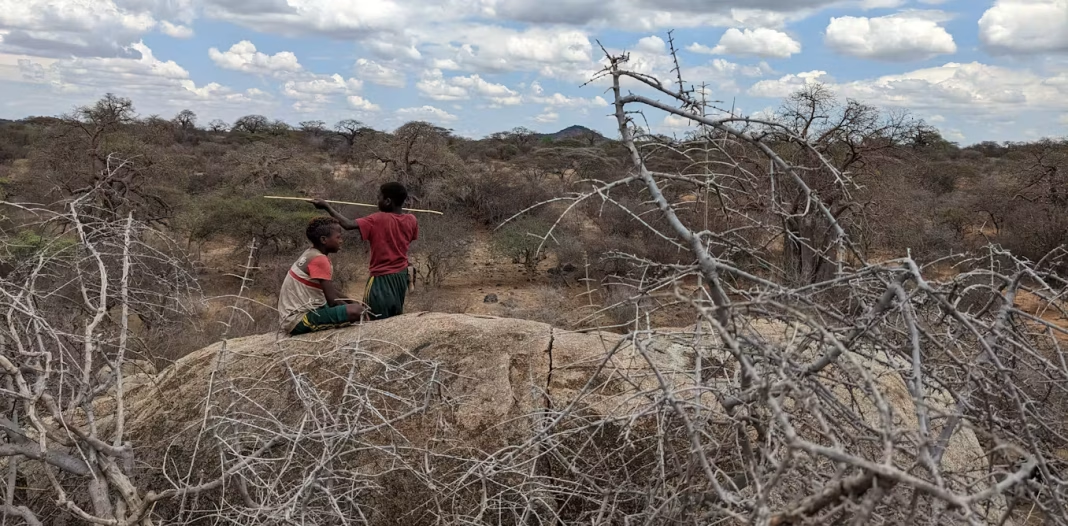

On the shores of Lake Eyasi in Northern Tanzania, a small number of people still hunt and gather their food. Today a Hadza hunter has taken down an animal – a kudu. He can’t carry it by himself, so he cuts his poisoned arrow from its flank, covers the carcass in dry grass to hide it from hyenas and heads home to enlist help.

Duncan Stibbard Hawkes
News spreads like wildfire across the camp. Everybody rushes to the kill. They divide up the carcass, carry it back, then divvy it up some more. Every family gets some, and after the meat is cooked, there’s more sharing still. On a good day like today, the hunter and his family retain half, but sometimes they keep much less. People may even walk from other camps, and almost everyone, from miles around, is entitled to a share.
The post-hunt scene above is idyllic. It paints a quintessential picture of egalitarianism and equality. But our experience as anthropologists working with the Hadza people of Tanzania and with the Tsimane people of Bolivia’s Amazon rainforest is that inequalities are part of even the most equal of societies. Furthermore, the equalities that do exist often emerge from selfish motives.
Insights like ours are revising researchers’ understanding of both the past and how people operate today, as inequality grows globally. Hunter-gatherers are often at the center of heated academic battles about what it means to be human, including debates over gender, war and peace and whether humans are, by nature, egalitarian or hierarchical.
Sometimes these debates oversimplify. So we pulled together hundreds of different sources covering more than a century of ethnography to find out just how egalitarian hunter-gatherer and other subsistence societies really are.

Christopher von Rueden
Is any society truly egalitarian?
Anthropologists have called hunter-gatherers such as the Hadza “egalitarian societies,” with equalities of power, wealth and social status. And it’s true that the traditional subsistence communities we work with successfully limit many inequalities.
Most families have similar, modest possessions and store little material wealth. When leaders do emerge, they are highly constrained in how they can direct other people. People often make decisions via consensus, and, if they cannot reach agreement, families will move away.
While the same anthropologists also emphasize that some hunter-gatherers are very unequal and that equality takes deliberate effort, the prevailing impression is that equality characterizes hunter-gatherers, past and present.
A quick trip to your local bookshop will reveal grand claims, including that past hunter-gatherer societies had no permanent leadership and no hierarchy, inequality only spread with the development of agriculture, and humans are noble by nature.
Some scientists are pushing back against these utopian portrayals. The popular bestseller, “The Dawn of Everything,” calls egalitarianism a “Garden of Eden narrative” that lacks substance. Other scholars have called egalitarian societies a scientific origin myth.
So where does the truth lie? Probably somewhere in between.

Duncan Stibbard Hawkes
Inequality among hunter-gatherers
In our recent wide-ranging review of the evidence from the early 20th century onward, we found that no society lacked inequality.
Like the Hadza, the Ju/’Hoansi of the Kalahari desert in southern Africa had little property and widespread food-sharing, yet certain families controlled valuable hunting territory surrounding waterholes. The Bayaka of the central African rainforest had little material inequality, yet they bought, sold and hoarded ritual knowledge. The Philippine Agta controlled and arranged their children’s marriages, hugely discriminating against orphans.
Gender inequalities were commonplace. The Tanzanian Hadza keep certain cuts of meat exclusively for older men, and give more respect to better hunters. Across societies, women have universally done more direct parenting, and men have participated more frequently in community-level decision-making.
No society lacks informal leadership. Age was another source of inequality. In many Australian societies, older men controlled ritual secrets and had power over the marriage choices of younger relatives.
Equality arises from self-interest
Our study also found that although hunter-gatherers are frequently generous, the processes limiting inequality often do not require any generosity. Instead, equality often results from people’s self-interested motives to acquire resources, status and autonomy.
A great example of this is food-sharing. Although each Hadza family gets a cut of kudu meat, it often happens not because the hunter’s family prioritizes total equality, but because other families request it vociferously. It can involve more taking than giving, often through strongly stated demands or complaints.
Another example is ridicule and mockery of stingy or braggadocious individuals, which keeps greed and bravado in check. Paradoxically, status-seeking can also promote equality, when cooperating to gain status diffuses status throughout the community.

Christopher von Rueden
Egalitarianism is alive and well
Many of these inequality-reducing processes are familiar to people everywhere.
Ridicule and mockery are ubiquitous in industrialized societies, from political cartoons to social media. Lampooning authority is even common in autocratic societies where governments spend large sums of money suppressing speech. Demands and complaints form the basis of strikes and collective bargaining. And key to social mobility is cooperation among people of different social strata.
Like many great debates, the truth is complex: Our ancient hunter-gatherer ancestors didn’t reach the giddy heights of inequality seen in other societies over the last 6,000 years, but putting hunter-gatherers on a pedestal as paragons of equality is a mistake. Sweeping statements about equality in the past blind us to the tools that probably allowed ancient hunter-gatherers to combat inequality, just as they and people in all societies do today.
Egalitarianism, then, is best seen not as perfect equality but as a set of tools that people use to secure their own autonomy and access to resources. Equality along one dimension or another might be the outcome, but it doesn’t rely on people being amazingly noble or completely lacking in greed or status-seeking. If you consider egalitarianism as equality-creating processes, you can see that it is a widespread reality among hunter-gatherer societies, and beyond.