


The crisis in the Strait of Hormuz, wider tensions in the Red Sea and the oil price spikes these circumstances occassion have made one thing abundantly clear: Gulf countries and global markets are dependent on vulnerable maritime routes.
But while national leaders and diplomats work to free up crucial waterways through which much of the world’s trade passes, another transport phenomenon is tentatively underway. For over 15 years, six Arab Gulf countries have been quietly cooperating to build a railway network – and the project has recently accelerated.
The aim is to increase the Gulf’s economic integration and improve the region’s resilience and security. But as experts of global governance and political economy, we also ask: Could such a rail project help reshape politics and conflict in the region?
That question is especially salient now, given that the U.S.-Iran war has meant months of severely disrupted and largely halted shipping in the Strait of Hormuz.
Putting regional integration on track
Routes in and out of the Persian Gulf region have long been subject to outside influence from military powers and bitter regional rivalries and conflicts. That has included Portuguese control of Hormuz during part of the 16th and 17th centuries, and British and American naval and airpower.
Since the founding of the Gulf Cooperation Council in 1981, leaders of its six member countries – Bahrain, Kuwait, Oman, Qatar, Saudi Arabia and the United Arab Emirates – have channeled efforts into regional integration. But despite 45 years of summits and joint declarations, economic and political cooperation has generally lagged behind rhetoric.
The current war in Iran has served to underscore the need for Gulf cooperation, and the GCC Railway project may be the means by which this is finally achieved.
Announced at the 30th summit of the council in 2009, the project aims to build a 1,352-mile (2,177-kilometer) railway network connecting the six GCC states at a projected cost of US$250 billion. The plan envisions standard gauge freight and passenger rail services with speeds between 50-60 mph (80-100 kph) for freight and 120 mph (200 kph) for passenger rail, all to be equipped with European train control technologies.
After initially slow progress, mostly due to periods of low oil prices that delayed many investments in the fossil fuel-rich countries, the UAE and Saudi Arabia led an acceleration of the project in the 2020s.
Then came the war with Iran. In April 2026 the GCC leaders gathered in Jeddah in Saudi Arabia amid strikes from Tehran against Gulf states and the crisis closure of the Strait of Hormuz.
The gathered kingdoms called for increased security cooperation as well as joint electricity and oil pipeline connections between GCC states. They also pledged expedited construction and completion of the GCC railway project.
With GCC countries responsible for building and operating its section of the project, Saudi Arabia and the UAE have made the most progress to date.
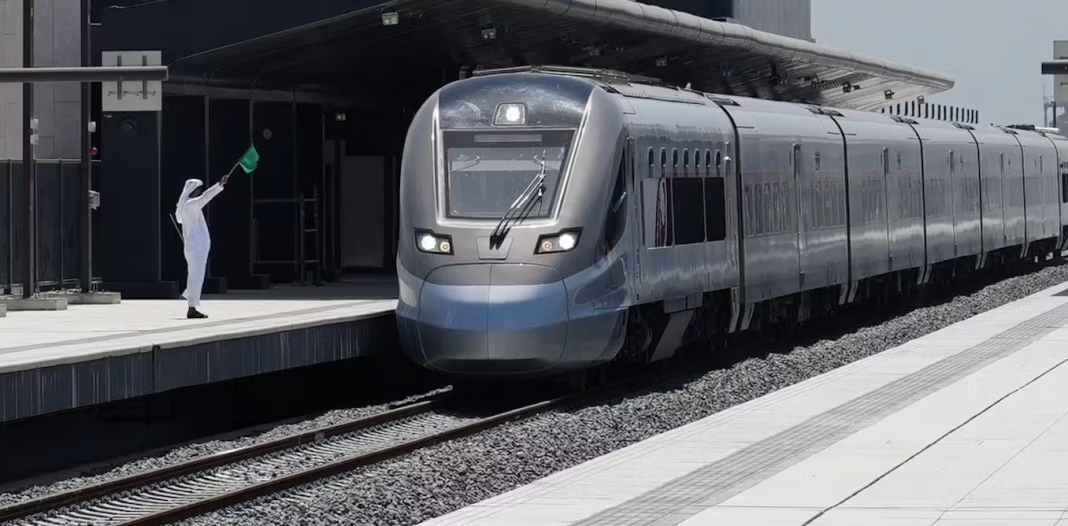
The UAE launched Etihad Rail in June 2026, transporting passengers between Abu Dhabi and Fujairah. A full service line from the Gulf of Oman to the Saudi border is scheduled to open by the end of the year; construction of the UAE-Oman segment is well underway; and Qatar, Bahrain and Kuwait are moving their sections through planning and design processes.
Earlier in 2026 the director of the GCC Rail Authority noted the project had reached 50% completion and is on track to be operational in 2030.
More connections to Europe and Asia
Once completed, the network will create the Gulf region’s first integrated, cross-border rail system, stretching from ports on the Gulf of Oman to Kuwait City.
But even more transformative integration plans are taking shape.
Several potential connections to Europe are under consideration or in development.
The GCC Railway could connect the Gulf of Oman and all six GCC member countries to Europe through several possible routes:
- From Kuwait through Iraq and Turkey.
- Across Saudi Arabia through Jordan, Syria and Turkey.
- Across Saudi Arabia, through Jordan to the Israeli port of Haifa.
- Across Saudi Arabia’s “Landbridge” to Red Sea ports and by ship through the Suez Canal.
GCC Railway ports on the Gulf of Oman, including the existing port in the UAE’s Fujairah and the expanding facilities in Sohar, Oman, will connect Gulf countries to Asian markets via the Arabian Sea and Indian Ocean. That network will offer valuable alternatives to the Strait of Hormuz during times of crisis.
Several efforts to realize these corridors are already underway and backed by major investment from both inside and outside the Gulf.
They include the India-Middle East-Europe Economic Corridor, backed by India, the EU, the United States and several Persian Gulf states; Saudi Arabia’s Landbridge from Riyadh to the Red Sea port city of Jeddah – which has seen its design contract already signed; and Iraq’s Development Road Project.
In June 2026, Saudi Arabia and Turkey signed a memorandum of understanding on railway connectivity that includes reviving and upgrading the century-old Hejaz Railway to reconnect Turkey to Saudi Arabia via Jordan and Syria.
All four of these initiatives plan to expand rail links from Gulf countries to Europe or the Mediterranean Sea.
Reshaping regional and global order?
The GCC Railway and its future connections, however, are more than mere infrastructure. It will also connect tens of millions of travelers across borders for business and tourism. And the railway network will make it easier for international visitors to travel across multiple Gulf countries, creating new opportunities for regional tourism.
Such connections can support political stability and development as well. For example, Iraq’s Development Road project has the potential to transform GCC-Iraq relations from one largely defined by security concerns and the spread of Iranian influence into one centered on economic connectivity and shared development interests. Similarly, greater GCC integration might engender more investment and economic growth in post-civil war Syria.
Additionally, the new connectivity would offer opportunities to avoid future conflicts between GCC states, such as the Qatar blockade.
In the short term, GCC leaders are likely to see improved economic and political cooperation as a counterbalance to Iran. But in the longer term, the project’s effects might lead to improving relations between Iran and GCC states.
Giuseppe Cacace/AFP via Getty Images
Potentially transformative connections
Historically, railways have played transformative roles in the making of countries, including the U.S. and Canada. They have also connected Europe and helped to modernize postwar Japan and contemporary China.
We believe the GCC Railway is best understood in that broader historical context. It is more than physical infrastructure – it represents a shared, strategic effort to strengthen regional resilience, deepen economic integration, reduce dependence on the Strait of Hormuz and position GCC states as links between Asia, the Middle East and Europe.
Railways cannot prevent wars or eliminate geopolitical rivalries. But over time, infrastructure can reshape the incentives and identities that drive behaviors and decisions. Railways can put more meaningful regional collaboration on track.