


A leader who stood up to U.S. President Donald Trump just won an election in Latin America’s biggest country, reversing a trend of new right-wing governments in the region over the past two years.
Incumbent Luiz Inácio Lula da Silva, having narrowly lost to Flávio Bolsonaro in the first round of voting on Oct. 5, 2026, staged a remarkable comeback on Oct. 25. He erased the deficit and won the all-important runoff election by more than 3.5 percentage points – more than 4 million votes.
It was a stunning result for the leader who proved to be the first Brazilian candidate to win a presidential election after not winning the first round, and who had been all but written off for a possible win. As a professor of Latin American politics, I believe the result offers a number of key political lessons for Brazil, Latin America – and even the United States.
A contest of worldviews — and social media
The choice in the second-round election was stark. Lula offered measures to ameliorate steep income inequalities and an economy built on a transition to clean energy, environmental protection and increased access to higher education and technical training. On international matters, Lula balanced defending Brazilian sovereignty from a Trump administration keen on meddling in Latin America, and maintaining good relations with an array of nations and blocs, including the European Union and China.
Bolsonaro, meanwhile, promised sweeping cuts to government spending, more militarized policing and eager support for the Trump administration’s campaign against drug violence. His pitch also came with offers to U.S. investors of access to critical minerals in Brazil.
Such right-wing populism has been ascendant in Latin America of late, and Lula also had to overcome an anti-incumbent mood, brought on by high prices, stagnant salaries, steep interest rates and a massive corruption scandal involving Brazilian elites. That banking probe directly ensnared Bolsonaro himself, as well as powerful Supreme Court justice Alexandre de Moraes, whom Bolsonaro’s supporters had tried to link to Lula.
Lula also had to neuter a social media landscape that has been dominated by images and narratives disparaging the president and his Workers’ Party.
Right-wing dominance of that online ecosystem helped carry Jair Bolsonaro, the 2026 hopeful’s father, to power in 2018 and got him close to reelection in 2022.
Especially after the first-round results in the 2026 vote, many analysts assumed the same pro-Bolsonaro social media presence would once again be hegemonic.
AP Photo/Andre Penner
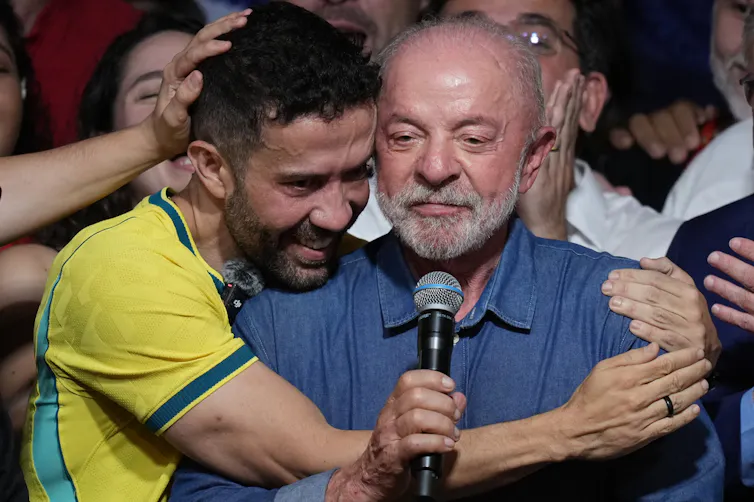
Instead, after the first round, a network of young, tech-savvy pro-Lula communicators created and shared effective, often amusing videos on WhatsApp and Instagram.
And they appealed to the center and even some of the right. All told, Lula easily made up more than 2 million votes by which he lost in the first round. He didn’t just increase turnout by millions and lower abstention rates; he also saw the state with the country’s second-largest electorate, Minas Gerais, flip to his side entirely – a swing of nearly 700,000 votes.
Emblematic of the strength of the campaign was the growth in subscribers to the WhatsApp channel Lula’s Army, which grew from 50,000 on Oct. 5 to more than 10 million by the night of the historic election.
The creator of the channel, André Janones, is a federal deputy for the Rede Party, an ally of the Workers’ Party, and a rising star in the circle around Lula. Likewise, Ana Elisa Santos Silva, a 21-year-old digital influencer and law student in the Workers’ Party, got the most votes of any federal deputy in the swing state of Minas Gerais.
Cracks in the ‘Americanization’ theory of politics
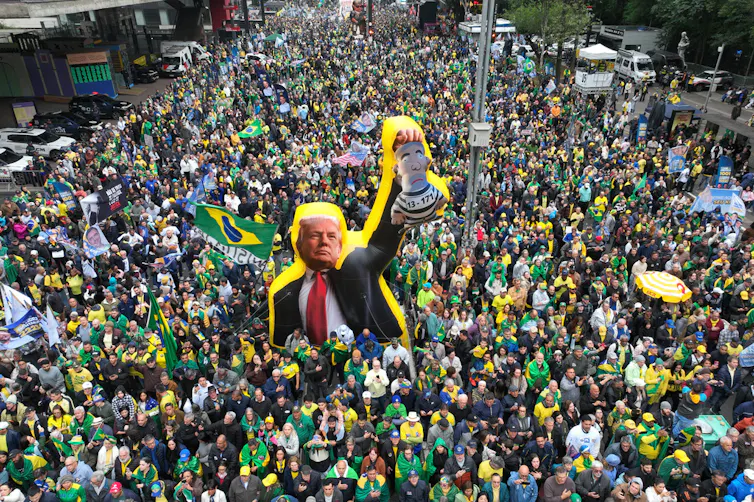
A prevalent narrative of Brazilian politics has held that the country’s divisions increasingly mirror those of the United States.
Part of that idea is due to Trump’s loss in the 2020 election and the resulting attack on the U.S. Capitol on Jan. 6, 2021, which eerily presaged events following Jair Bolsanaro’s 2022 loss.
Like in the U.S., there has also been a rapid rise of a politically active evangelical right in Brazil.
AP Photo/Andre Penner
More fundamentally, proponents of the Americanization thesis hold that U.S.-style deindustrialization and “Uberization” of the Brazilian economy have led to a decline of the unionized working class – a core support base for the left – and its replacement by an army of gig employees dreaming of owning their own businesses and throwing off the shackles of the taxing and regulating state.
Yet similarities between the two countries shouldn’t be confused for politics always moving on parallel tracks.
Survey research suggests that many Brazilians see the state as responsible for the realization of their constitutionally protected social rights, including healthcare, education and pensions. Many also regard government employment as inherently more stable and dignified than the harsh labor markets of the private sector, especially for the relatively unskilled.
For all of the apparent rise in American-style libertarian politics in Brazil, the reality is that such a viewpoint remains much smaller in the country. Flávio Bolsonaro’s bet, like his father’s before him, was that this strain of libertarian right-wing politics could nonetheless propel him to victory, much as it apparently had for Javier Milei in Argentina in 2023. But it was not enough.
One election can’t fix deep polarization
Even with Lula’s win, Flávio Bolsonaro’s Liberal Party did exceptionally well at the legislative level.
When the next Brazilian Congress convenes on Feb. 1, 2027, the Liberal Party will control 28 seats in the Senate – 35% of the total; and 121 seats in the lower house – 24% of the total (as well as five governorships, which are 19% of the total).
When factoring in expected Liberal Party allies, it is clear that the right will have bigger majorities in both houses for Lula’s next administration. That will help Congress solidify control vis-a-vis the executive branch in terms of legislation and, crucially, the budget.
A series of unknowns facing Lula
The election raises several questions.
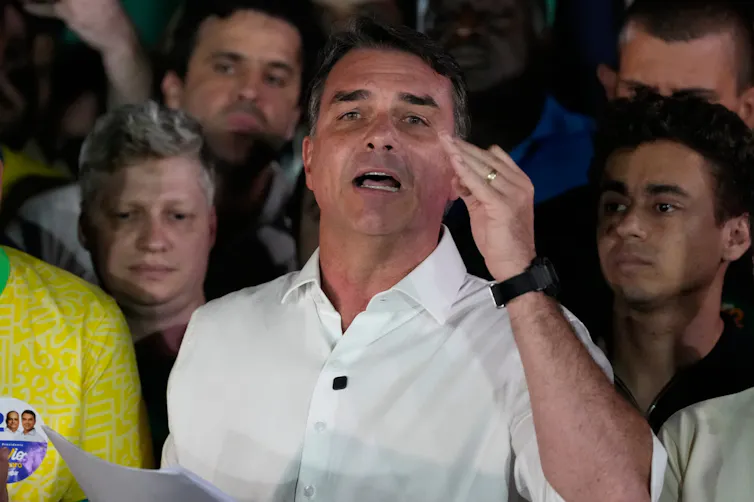
First, it is unclear how Lula, who will turn 81 on Oct. 27, will be able to effectively govern. The president will have to make major concessions to a Congress with little capacity for responsibly delivering coherent policy.
The federal Supreme Court is also seen as politicized, fragmented and tainted by scandals. On the other hand, Lula could appoint four new Supreme Court justices because of upcoming retirements, meaning that he could shape the country’s highest judicial body in a way that enhances his ability to manage Congress.
AP Photo/Eraldo Peres
Yet it might be difficult for Lula to simultaneously meet the demands coming from Congress and those from the business community. For example, many will push the government to curb the fiscal deficit, currently running at a very high annual level of close to 8% of gross domestic product.
A second question is whether Bolsonaro’s loss will splinter the right. One interpretation of the 2026 election is that to be competitive, the right will want to move on from the Bolsonaro family. One potential figure is Tarcísio de Freitas, a former cabinet member in the Jair Bolsonaro government and popular governor of São Paulo. Yet there are nonetheless five members of the Bolsonaro family in the new Congress, and they are likely to try to keep together the coalition that fought for Flávio Bolsonaro’s campaign.
Finally, it’s not clear how the Trump administration, which interfered decisively against Lula’s agenda, will react to his win – and to what extent it will support Bolsonaro’s denial of his election loss even though it was bigger than his father’s in 2022.
Whatever the extent of any interference, the Trump administration’s right-wing Latin American vision invariably sets up conflict with Lula. Yet while the Trump preference was always for Flávio Bolsonaro, that doesn’t mean his administration won’t pragmatically engage with Lula even as it pressures his government. For his part, Lula continues to hold his own leverage, including through Brazil’s large deposits of rare earth elements that the Trump administration covets.
If the past eight years of Brazilian politics are any guide, Lula’s next administration is likely to be a turbulent one in which enduring divisions at home and abroad are continually tested.