


Europe is again embroiled in a contentious debate about immigration.
On Aug. 4, 2026, European interior ministers met for an EU-wide crisis meeting on borders. This followed days of accusations, recriminations and in-fighting among EU member states over an incident in which approximately 70,000 people crossed from Morocco to the small Spanish enclave of Ceuta on the North African coast.
Many swam several miles in the Mediterranean to avoid the heavily fortified border fence – leaving 88 people drowned in just 48 hours. While Spanish police escorted most of the individuals back to Morocco with the help of Moroccan authorities, the European far right quickly latched on to the episode as fodder to further fuel its anti-migrant policies.
While this is not the first time thousands of migrants have crossed into Ceuta, the moment has sparked a new diplomatic crisis in the European Union, hearkening back to the 2015 “crisis” when migration likewise threatened to destabilize the bloc. As in the earlier case, the latest episode was not merely a result of misinformation or vast numbers of people looking for safety in Europe, but a reflection of disagreements and lack of coordinated action in Brussels.
What explains last week’s sudden rise in migration
Moroccans, especially in the north, have long felt discontent at the disparity between their local communities and the Spanish enclaves that are only a few miles apart. Many cite the lack of jobs or educational opportunities as reasons to migrate. The GDP per capita in Morocco was only US$4,153 in 2024 compared to $26,774 in Ceuta. This inequality has led some Moroccan “mule women” to haul goods on their backs for sale in Ceuta under dangerous and even deadly conditions.
Under normal circumstances, several thousand migrants cross without documents to the Spanish enclaves of Ceuta and Melilla each year. From January to April 2026, 2,582 people crossed to Ceuta and roughly 1,000 people claimed asylum.
Observers have offered various theories as to why that number spiked so high last week.
Pedro Sánchez, the Spanish prime minister, blamed trafficking groups that spread rumors online about a recent Supreme Court decision that Spain could not return people if they arrived by sea. When journalists interviewed migrants, many said that social media posts sparked hope that they could swim to Ceuta and eventually travel to Europe for work and a better life.
The Spanish court decision was wrestling with a difficult legal question: How and when can migrants apply for asylum when they arrive at Spain’s borders? This echoes debates addressed by the U.S. Supreme Court in June when it supported the Trump administration’s pushbacks at the southern U.S. border, arguing that migrants could not apply for asylum because they had not technically crossed into U.S. territory. Of course, they were not in the U.S. because the border guards had pushed them back.
The Spanish decision was more narrow: It agreed that migrants cannot be pushed back if they arrive by sea because there were no physical elements to the maritime border. If the government installed a floating wall extending Ceuta’s border fence into the sea, which it has now done, then pushbacks would be legal.
Nevertheless, Spanish police have escorted nearly all migrants back to Morocco, with only some individuals from non-Moroccan nationalities allowed to apply for asylum and some unaccompanied Moroccan minors allowed to remain.
Morocco’s interests
Ceuta, along with Melilla, have been under Spanish control for four centuries, though Morocco considers the enclaves to be occupied Moroccan territory.

AP Photo/Marius Burgelman
Beginning in the 1990s and increasingly throughout the 2000s, Spain took steps to strengthen the border fortifications between the enclaves and Morocco, primarily out of fear that migrants from sub-Saharan Africa would cross into Melilla or Ceuta en route to mainland Europe.
Morocco has largely cooperated with the EU to block migration in exchange for large financial inducements and diplomatic benefits, though that relationship briefly faltered in 2021 over issues related to the Moroccan-occupied territory of Western Sahara.
In retaliation over Spain’s decision that year to permit medical treatment for the leader of Western Sahara’s Polisario Front, a banned pro-independence group, Moroccan border guards allowed approximately 12,000 people to cross into Ceuta over two days. The dispute was overcome only after Sánchez made overtures to Morocco, acknowledging its rule over the territory.
This time around, it is similarly unlikely that tens of thousands of individuals would have been able to cross without the complicity of Moroccan border guards. That led some observers to speculate that the episode was once again Moroccan retaliation toward Spanish positioning on the issue of Western Sahara. The Spanish prime minister visited Algeria, the primary political and financial backer of the Polisario Front, days before the Ceuta episode.
The post-2015 paradigm
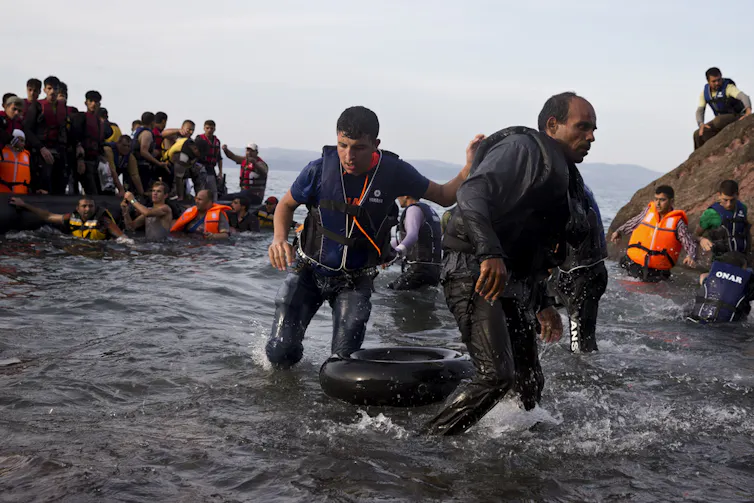
The July events also make clear that the EU is operating in the long shadow of the 2015 migration “crisis,” when more than 1 million people arrived in Greece and Italy from Turkey and North Africa, respectively.
Some countries suspended the Schengen zone, which allows for the internal free movement of goods and people across 29 European countries, and restarted border checks. The European Council adopted a mandatory quota to share the refugee burden more equitably across all member states, but it fell apart in acrimony and finger-pointing when Hungary, Poland and the Czech Republic refused to participate.
For years, legislation to reform EU migration policy stalled in Brussels, leaving the EU with one primary policy tool: migration management aid. The EU poured nearly $6 billion (more than 5 billion euros) in foreign aid to countries including Morocco to address the “root causes of migration,” but the aid did not stop migration. Instead, as our new book “Aiding Autocrats” shows, Europe’s migration aid has empowered authoritarian leaders and risks greater repression.
AP Photo/Petros Giannakouris
While Morocco is often treated as a stable and reliable North African partner by both Europe and the U.S., Moroccans face an often repressive and dismissive government that has failed to address the economic concerns of its citizens. Over the course of the past decade, the government violently crushed popular protests focused on economic and political demands, such as addressing unemployment and reducing corruption. Those demonstrations were especially prominent in the north of the country near Ceuta.
In 2024, after years of trying, the EU finally agreed upon a much more strict continentwide immigration plan, helping to solidify the bloc’s move to the right. The EU Pact on Migration and Asylum, which emphasizes faster deportations and fewer rights of appeal for asylum-seekers, came into effect in June 2026.
Impact across Europe
Italian Prime Minister Giorgia Meloni, perhaps the EU’s leading right-wing immigration restrictionist, latched onto the Ceuta episode. She claimed that “uncontrolled illegal immigration poses a real threat to the security of Europe’s borders.” Italy, along with Finland, Austria, Sweden, Denmark and the Czech Republic, called for Spain to be suspended from the Schengen zone. Meloni also reintroduced border checks with Spain, even though Ceuta is not part of the free movement zone, and Spain and Italy do not share a land border.
The emergency summit on Aug. 4 continued the pattern of the 2015 political crisis, after which the EU held more than 20 summits on migration, attempting to corral member states into coordinated actions.
Ahead of the latest summit, European leaders argued that Spain’s plan to provide residency and work permits to 500,000 undocumented migrants had incentivized last week’s sudden increase in arrivals.
That would buck historical precedent, however. Both Italy and Greece had large campaigns to grant legal status to undocumented migrants in the 1990s and 2000s, and researchers found no evidence that so-called regularization processes led to further undocumented migration. U.S. President Ronald Reagan also oversaw an amnesty program that legalized nearly 3 million people in 1986 and decreased the number of undocumented migrants for decades afterward.
Following the EU summit, member states appeared to be placated, and the European Commission promised to double down on funding for border security, cooperation with African governments and increased deportations.
Realistically, however, as long as Europe continues using aid to enhance border security without addressing underlying issues such as economic disparities and poor governance in neighboring countries, there will likely be more incidents of sudden, chaotic, large-scale migration, not less.