



Russian opposition leader Alexei Navalny died in prison after being poisoned with a deadly toxin found in Ecuadorian dart frogs, the UK and other allies have claimed.
The “barbaric” act – using a neurotoxin that is classed as a chemical weapon – could only have been carried out by Vladimir Putin’s government, they said on Saturday.
It is not clear how the frog poison – called epibatidine – was allegedly administered to Mr Navalny, who had been in a penal colony in Siberia when he died almost exactly two years ago.
Indigenous tribes in South America are said to use the toxin in blow darts or blowguns when they hunt.
The poison is 200 times stronger than morphine.
Yulia Navalnaya, the Russian dissident’s widow, appeared at a press conference on the sidelines of a security conference in Munich to announce the discovery, flanked by the foreign ministers of the UK, Germany, Sweden and the Netherlands.
The four countries and France have been working together to establish how Mr Navalny, 47, died.
They plan to submit their findings to the UN’s chemical weapons watchdog, the Organisation for the Prohibition of Chemical Weapons (OPCW).
“It is hard for me to find the right words,” Mrs Navalnya said in English, looking visibly upset.
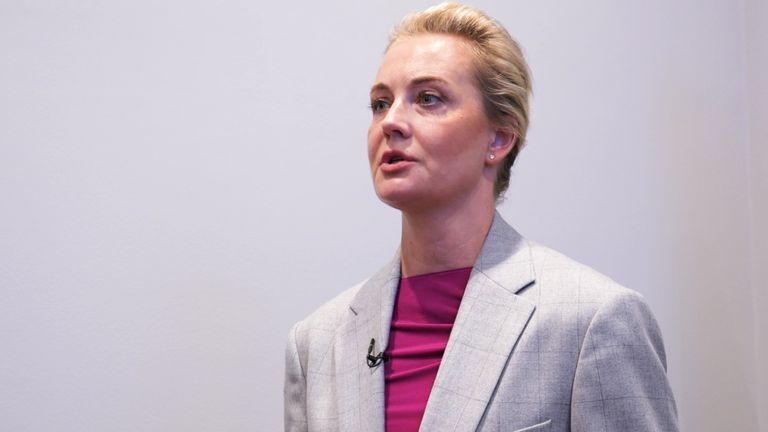
Yulia Navalnaya was visibly upset at times
She had been at the Munich Security Conference when the news of her husband’s death broke on 16 February 2024.
“It was the most horrible day in my life. I came to the stage and I said my husband, Alexei Navalny, was poisoned. What could else happen with Putin’s number one enemy in a Russian prison?
“But now I understand and I know it is not just words. It is scientific proof.”
Russian authorities have previously claimed the dissident’s death was not suspicious but had been caused as a result of “combined diseases”, including an irregular heartbeat.
But Yvette Cooper, the British foreign secretary, said the UK and its allies had been working “with fierce determination” to establish what really happened.
It is understood that British scientists at Porton Down played a key role in the discovery of the frog poison scheme.
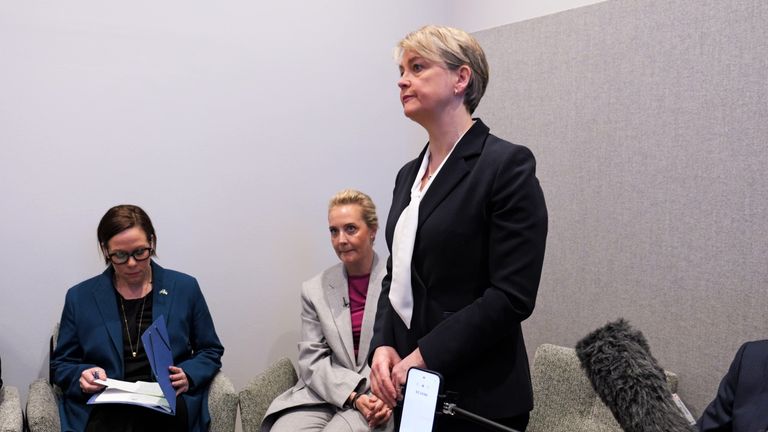
UK Foreign Secretary, Yvette Cooper (right), and Yulia Navalnaya
It was not immediately clear how they were able to obtain samples from Mr Navalny’s body to test for the toxin, though Ms Navalnaya has previously said they were smuggled out of Russia.
The opposition leader was buried in the suburbs of Moscow in March 2024.
“As a result of the work of the UK, Sweden and other partners, we have confirmed that a deadly toxin was found in Alexei Navalny’s body,” Ms Cooper told journalists,
“And that toxin has been identified as a toxin that is found in Ecuadorian Dart Frogs.”
She said: “Only the Russian government had the means, the motive and the opportunity to use that toxin against Alexei Navalny in prison and that is why we are here today to shine a spotlight on the Kremlin’s barbaric attempt to silence Alexei Navalny’s voice.
“To show that the Russian government has contempt for its citizens and the willingness to use this deadly toxin.”
The top British diplomat also quoted Mr Navalny himself about the need to hold the Russian government to account.
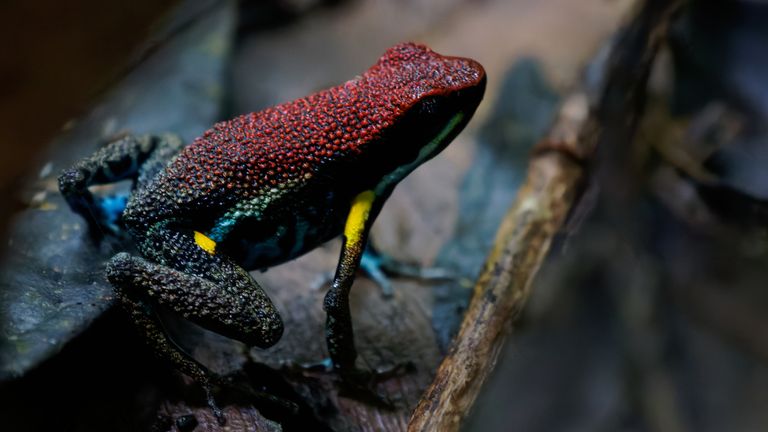
An ameerega bilinguis, more commonly known as an Ecuador poison frog (file pic)
Read more from Sky News:
Mandelson’s assistant sent Epstein government speech prior to delivery
This shocking illegal M25 waste site has kept on growing
“He said: ‘We must do what they fear, tell the truth, spread the truth that is the most powerful weapon’.”
Johann Wadephul, the German foreign minister, shared details about the effect of being poisoned by the dart frog toxin, calling it a “particularly strong” nerve poison.
“The victims suffocate in agony,” he said.
Sweden’s foreign minister, Maria Malmer Stenergard, explained why it was necessary to understand the true cause of Mr Navalny’s death.
“This is extremely important in order to be able to hold Russia accountable for what they have been doing and to continue to shine a light on their continuous lies,” he said.
“We will now move forward with this information to the OPCW… This is yet another way to increase the pressure on Russia.”
The Kremlin has yet to respond to the allegation.
President Putin’s government has already been accused of previously trying to kill Mr Navalny in 2020 using a Novichok nerve agent – the same chemical weapon that Russia is believed to have deployed on the streets of Salisbury in a failed attempt to kill a former Russian double agent, Sergei Skripal, and his daughter in 2018.
Mr Navalny survived the original poisoning and recuperated in Germany before returning home to Russia, where he was arrested and jailed.