



Curious Kids is a series for children of all ages. If you have a question you’d like an expert to answer, send it to CuriousKidsUS@theconversation.com.
What was the first animal on Earth? – Keira, age 10, Eugene, Oregon, and Julian, age 7, South Bend, Indiana
Imagine climbing into a time machine and setting the dial for when the very first animal was alive. You would need to travel really, really far back in time.
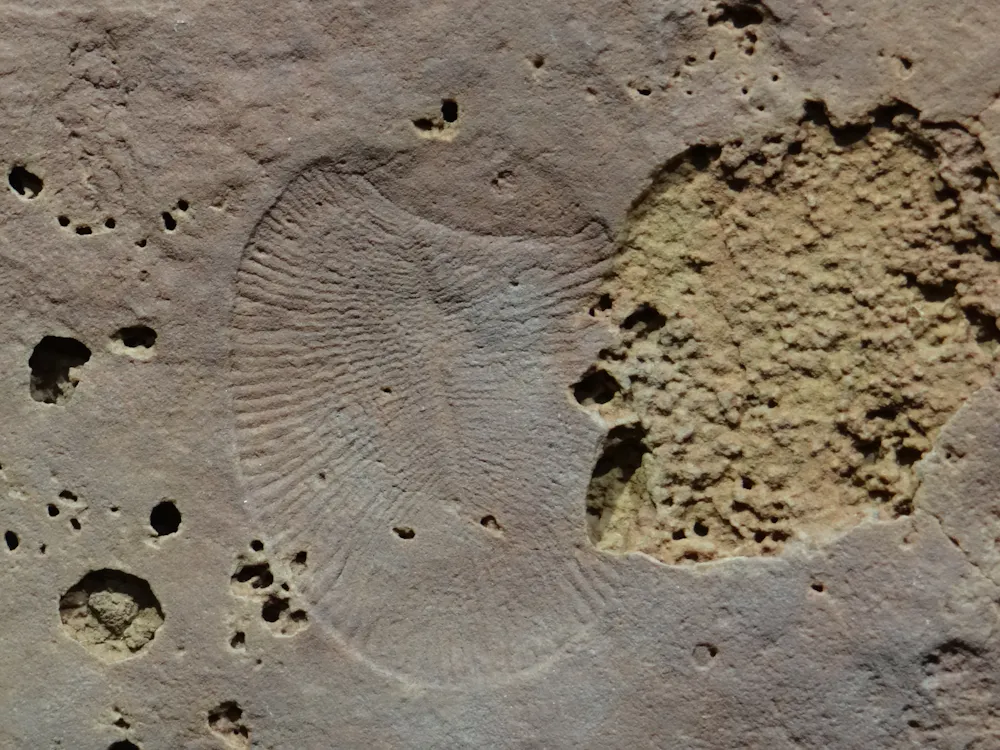
You would blow past the dinosaurs, which showed up about 230 million years ago. Keep going and you’d pass coil-shelled ammonites that swam in the oceans starting 450 million years ago, and then trilobites, armored animals that scuttled across the seafloor more than 520 million years ago. Further still, around 558 million years ago, you would meet Dickinsonia, a tiny, flat, ribbed oval only a few millimeters thick that looks more like a squashed pancake than any animal you know.
And even Dickinsonia was almost certainly not the first animal.
We are biologists who study single-celled life called protists. How complex life such as human beings showed up in the first place is one of the major questions in our field.
Honestly, nobody can name the first animal, but there are many clues about what it was probably like.
What makes an animal an animal?
If we asked you what an animal is, you might say something that moves, eats and reproduces. The trouble is that plenty of nonanimals do all three.
For instance, single-celled amoebae crawl, hunt and swallow their prey whole – and they are not animals at all!
Biologists define an animal as an organism made of many cells that stick together, communicate and divide up the work of growing, eating and moving. Different types of cells specialize to do different jobs, and they all work together as one organism. And when animals eat, they take in outside material instead of making their own food from sunlight the way plants do.
Notice what is not on that list: Legs. Eyes. A brain. A mouth. That matters for what comes next.
Consider the sea sponge
SpongeBob SquarePants is a cartoon version of a real animal, the sea sponge. Real sponges do not wear square pants; they don’t even move around. They sit anchored to the seafloor, pumping seawater through thousands of tiny holes and straining out bacteria to eat. They have no brain, no heart and no muscles.
But sponges are still animals, and scientists often think of them as the simplest ones. Part of what makes them so interesting is a type of cell they have called choanocytes. Each choanocyte has a whiplike tail ringed by tiny fingerlike projections that trap food.
Choanocytes look almost exactly like choanoflagellates, free-living, single-celled organisms that are the closest living relatives of animals. Watching a colony of choanoflagellates feed together is about as close as you can get to seeing the doorway between single-celled life and animal life.
Or were comb jellies first?
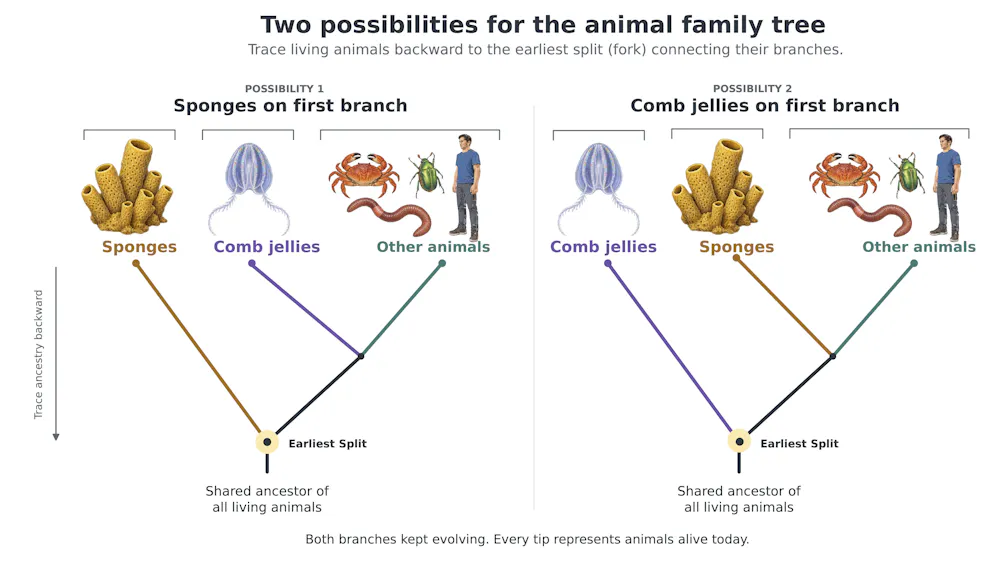
Imagine climbing down the animal tree of life going backward in time. You can start with animals alive today, which would be the leaves of the tree. Branches join where you encounter ancestors shared by different groups. Follow them far enough, and they all meet at a common ancestor of living animals. Scientists disagree about which groups belong on each side of that deepest branching point.
Matthew W. Brown
Some studies put sponges alone on one side of that fork, with every other living animal group, including us, on the other. Other studies put comb jellies in that position. In that case, these shimmering, jellylike ocean swimmers would occupy one side, while sponges and all other animals would occupy the other. This is what scientists mean when they describe either group as having “branched off first.”
It is important to remember that “branched off first” does not mean “unchanged.” Sponges, comb jellies and humans have all been evolving for the same amount of time, since our shared ancestor lived. Each lineage has followed its own evolutionary path, which over time has led to the great diversity of animals we see today, such as worms, insects, crabs and primates. Today’s sponges and comb jellies may therefore look very different from that common ancestor, making it difficult to picture what the first animal looked like.
What kinds of evidence tell the story?
Comparative biology can take us only so far.
cprevot/Wikimedia Commons, CC BY-SA
Fossils are another source of information, but they show just a very narrow window into the past. Fossilization turns living material into stone, a process that works far better on hard parts such as shells, teeth and bones than on soft, squishy bodies. Because early animals were probably soft and small, they were likely easily erased from the record.
Also, fossilization works better in some kinds of environments than others. For example, muddy lake bottoms can bury dead organisms, protecting their remains from rapid decay so they have time to fossilize; any remains on wave-battered shores may wash away before they can fossilize.
Another line of evidence now available to scientists is genetic information. Genes, encoded in DNA strands inside every living organism, provide an instruction manual for how to build that creature. Cells copy that DNA and pass it on – a process that’s been going on for billions of years, generation after generation.
This genetic information accumulates slight changes over time, which scientists call mutations. It is the very existence of mutations that allows evolution – how life changes over time – to happen. This process is what generated the diversity of life you see today.
By studying the structure and architecture of DNA, as well as how it gets passed along, scientists can mathematically assemble family trees that extend very deep into the past. These family trees can help scientists make surprisingly good guesses about when and where an animal first arose. A creature’s genes hint at what it could possibly do.
Animals were assembled, not invented
Biologist Iñaki Ruiz-Trillo and his colleagues use a smartphone analogy that we find particularly useful when talking about the origin of animals.
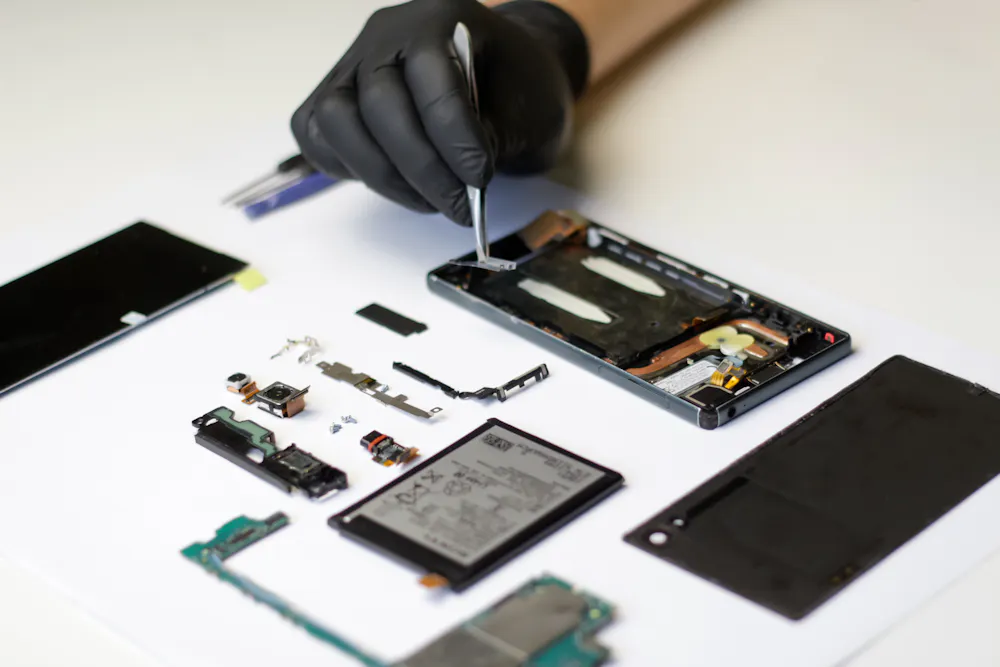
A smartphone was not invented from scratch. Cameras, telephones, computers and the internet were all invented separately first. The innovation was combining them into a single piece of equipment.
Tetiana Strilchuk/iStock via Getty Images Plus
Animals may have evolved in a similar way. Genes for sticking cells together, for sending signals between cells, for sensing the environment and for switching other genes on and off were already present in our single-celled relatives. Becoming an animal meant assembling that tool kit into one cooperating body.
The first animal was probably something very small, soft and unremarkable in an ancient ocean. It probably evolved over 650 million years ago. It certainly had different kinds of cells that were stuck together, doing specialized jobs.
Scientists may never be able to pinpoint the first animal, and we have a hard time trying to imagine it. But we do know that many of the cellular and molecular tools that helped early animal cells work together are still at work in your body today.
Hello, curious kids! Do you have a question you’d like an expert to answer? Ask an adult to send your question to CuriousKidsUS@theconversation.com. Please tell us your name, age and the city where you live.
And since curiosity has no age limit – adults, let us know what you’re wondering, too. We won’t be able to answer every question, but we will do our best.