


Elections are typically framed as a choice for voters. For Palestinian citizens of Israel, however, the country’s national ballots pose more of a dilemma.
Constituting about one-sixth of eligible voters in Israel, Palestinian citizens could hold the difference in a race expected to be close. But voting involves a trade-off: By casting a ballot for their best interests, many Palestinian citizens believe they also risk legitimizing a process that seeks to silence their voice and a system that treats their citizenship as conditional.
The coming Israeli election on Oct. 27, 2026, brings that tension to a new peak. Since the last general election in 2022, the destruction and mass killing in Gaza, restrictions on Palestinian citizens’ speech and protest and leading opposition parties’ rejection of having Arab political partners have sharpened the dilemma of seeking protection through institutions that reinforce their exclusion.
Having devoted most of my academic career to studying relations between Israel and its Palestinian citizens, I see the question facing Palestinian citizens of Israel as part of a much longer struggle over survival, citizenship and political belonging.
Citizenship as protection
The approximate 1.7 million Palestinian citizens of Israel – out of a total population of around 10 million Israeli citizens and 15 million people living under Israeli direct or indirect control – are largely the descendants of Arabs who stayed on land that became the state of Israel.
The category excludes the descendants of 750,000 Palestinians who were forced from their homes during the Arab-Israeli war of 1948 – most of whom were prevented from returning.
A hurried wartime census dated Nov. 8, 1948, helped determine who would be recognized as belonging to the new state. Registration and subsequent citizenship requirements excluded anyone who was absent from their home at the time of the census. This included Palestinians who had sought temporary shelter in neighboring countries or elsewhere in what was Mandatory Palestine.
Therefore, the census did more than count residents: In most cases, Palestinians displaced by the war who were absent when it was conducted were excluded from the population register. That made it almost impossible for them to obtain citizenship and return to their homes.
For those who remained, citizenship became a form of insurance against expulsion; once they were designated as citizens of Israel, their removal became legally much more difficult.
Despite its shortcomings – and its failure to prevent dispossession and repression – Israeli citizenship has still been taken particularly seriously by Palestinian citizens.
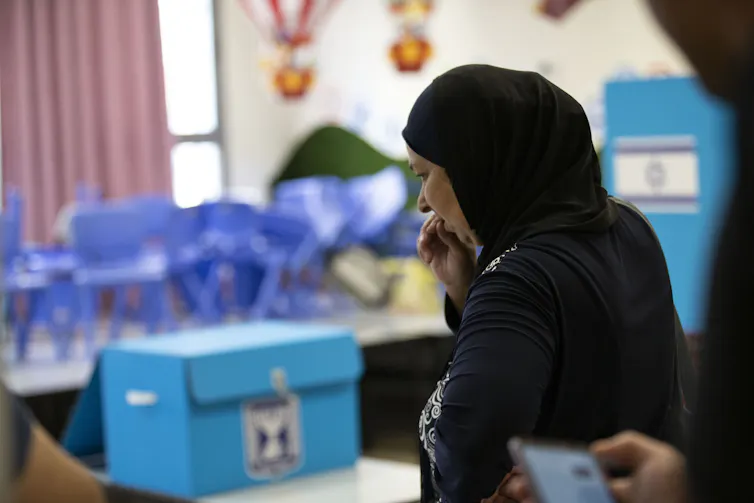
Photo by Mostafa Alkharouf/Anadolu Agency via Getty Images
Fluctuations in political influence
Palestinians today constitute approximately half the population in the territory between the Jordan River and the Mediterranean Sea: Israel, Gaza and the Occupied West Bank. But fewer than one-third of them possess Israeli citizenship. Those who do – and as such can participate in its national elections – constitute roughly 17% of Israel’s citizenry.
From the creation of the Israeli state onward, Palestinian citizens have been eligible to vote, but they have faced hurdles to full participation.
Since the 1970s, Palestinian politicians’ identification with the wider Palestinian struggle has prompted attempts to disqualify candidates and parties. The Supreme Court has generally blocked such exclusions.
In Israel’s first decades, most Palestinian votes went to the Jewish-Arab Communist Party, in its various incarnations, or to Arab lists – parties affiliated with the ruling Labor movement and acting on its behalf. The 1980s saw the disappearance of these satellite lists and the emergence of alternatives to the communists. For example, the Progressive List for Peace entered parliament in 1984, combining Palestinian nationalism with Jewish-Arab cooperation. Later, in 1988, the Arab Democratic Party emerged as an exclusively Arab party.
Except for short periods in the mid-1990s and 2021-2022, Israeli parties that consider themselves Zionist generally regarded none of these independent lists as legitimate coalition partners. But Palestinian parliamentary leverage reached a high point in 1992–1995, when Yitzhak Rabin’s government relied on support from two Arab-majority parties.
They pursued two connected goals: advancing what became known as the Oslo peace process in the hope that it would lead to Palestinian statehood, and reducing discrimination in funding communities.
Their leverage helped secure significant increases in public investment for Arab communites. Similarly, the short-lived anti-Netanyahu government of 2021–2022 relied on the support of an Arab party, enabling some limited improvements on local issues.
A narrowing political arena
Today, space for such Palestinian parliamentary influence appears narrower than it has been for decades, Since the early 2010s, moreover, Arab parties have increasingly faced official and unofficial attempts to neuter their influence.
In September, Israel’s Central Elections Committee sought to disqualify both Arab electoral lists – the Joint List and the United Arab List – as well as individual candidates. In the 2022 election, these lists’ constituent parties received approximately 86% of the votes cast in Arab localities. Disqualifying both lists would have deprived the vast majority of Palestinian voters of their preferred political representation.
The Supreme Court reversed the lists’ disqualifications but signaled that a majority of its judges would uphold the exclusion of the National Democratic Assembly’s leader, Sami Abu Shehadeh, over an article he wrote immediately after the Hamas-led attacks of Oct. 7, 2023. His critics interpreted it as endorsing the massacre of Israeli civilians, though Abu Shehadeh and others vigorously denied that claim.
Rather than demand a ruling, Abu Shehadeh withdrew his candidacy, explaining that he feared a damaging precedent that would restrict Palestinian political activity more broadly.

Erik Marmor/Getty Images
This exclusionary atmosphere extends beyond political institutions. In the Israel Democracy Institute’s July 2026 survey, about one-third of Jewish respondents opposed Arab citizens’ right to vote. Among supporters of Prime Minister Benjamin Netanyahu’s coalition parties, the proportion was approximately 55%.
Palestinian voters have also faced intimidation and voter suppression. Practical barriers compound this pressure. Residents of unrecognized Bedouin villages, for example, face long journeys to assigned polling stations.
The costs of participation – and abstention
While many Palestinians understand that participation legitimizes electoral rules under which their choices are limited, abstention surrenders opportunities to address issues such as the rise of organized crime and violent crime in Arab communities.
And although Palestinian parties could hold the balance of who gets to form a coalition, the reality is not that simple.
The differences between Netanyahu and much of his opposition regarding Palestinians’ rights and self-determination are largely that of style rather than policy. Neither Netanyahu’s ruling coalition nor the leading opposition parties support a two-state solution or offer any other credible route to ending the occupation.
Nevertheless, the main opposition depends more heavily on a secular middle class sensitive to global opinion that is increasingly turning against Israel over the dispossession and killing of Palestinians in the West Bank and Gaza.
This may be an exceptionally low threshold of expectation, but it reflects the choices available for Palestinian voters on such issues related to Palestinians living under occupation.
Personal security at home is an even more pressing concern for many Palestinian citizens of Israel. Criminal organizations terrorize Arab communities, while killings have reached unprecedented levels under the current government – largely through state complicity.
In a May survey, more than half of Arab respondents identified violence in their communities as the principal factor negatively affecting their mood. The urgency of this crisis helps explain widespread support for Arab participation in the next government – some 77% of the Arab citizens support this arrangement, which most Zionist opposition parties reject.
Can turnout shift the balance?
For Palestinian citizens, the electoral options remain limited. The United Arab List, a party rooted in the Muslim Brotherhood, now most explicitly advocates integration into Israel’s governing institutions. Seeking acceptance by Jewish parties, it has largely set aside Palestinian national rhetoric to prioritize its constituents’ immediate needs.
The Joint List, meanwhile, brings together nationalist and communist forces seeking to make Israeli citizenship substantive through equal rights, without abandoning explicit manifestations of Palestinian national identity and solidarity with other Palestinians. Its constituent parties disagree over how far cooperation with Zionist parties should extend.
Voting for a Zionist party remains another option, but its appeal has diminished sharply over recent decades. Such a trend, however diminished, persists particularly among constituencies with close institutional ties to the state.
Finally, Arab voters can abstain, and roughly 35% to 45% are expected to do so, compared with 25% to 30% among Jewish voters.
Palestinian voters abstain for reasons ranging from apathy to a deliberate boycott of the state established through their people’s dispossession. Recent attempts to suppress Arab representation could either mobilize citizens who feel their remaining protections slipping away or deepen their reluctance to participate in an arena so visibly stacked against them.
The outcome could shape the election, and Arab party leaders aspire to 70% turnout. Higher participation would increase Arab representation and could push marginal right-wing parties below the electoral threshold, weakening Netanyahu’s prospects of forming a government.
The hope of Arab party leaders is that, despite opposition leaders’ declarations against cooperation, a sufficiently large Arab parliamentary bloc will leave the Jewish opposition parties little choice but to seek its support to remove Netanyahu.