


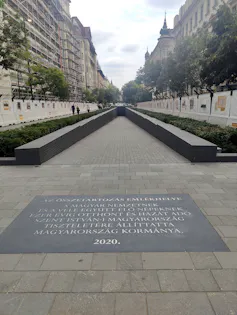
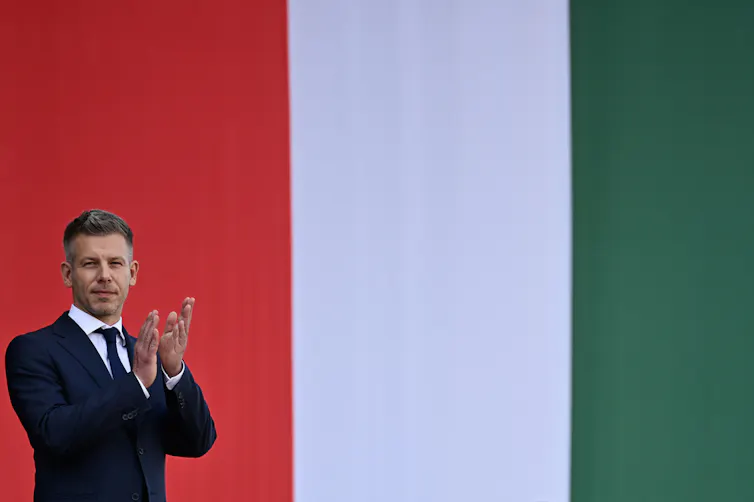
When newly elected Hungarian Prime Minister Péter Magyar delivered a June 4 address to mark Hungary’s Day of National Unity, he did so facing a long stone trench known as the Monument of National Unity. The memorial pays homage to the Treaty of Trianon in 1920, which formally ended Hungary’s involvement in World War I but also resulted in the nation losing about two-thirds of its territory, economy and population.
The monument is provocative in several ways. Its walls are covered with the Hungarianized names of more than 12,000 towns and cities that were once part of “Greater Hungary.” That’s the colloquial name for Hungary’s territory before World War I, when it was still a part of the Austro-Hungarian Empire. The monument incorporates thousands of places now in Slovakia, Romania, Serbia, Ukraine, Croatia, Slovenia, Austria and Poland. The names are intermixed rather than grouped geographically, suggesting the indivisibility of Greater Hungary despite modern borders.
When former Prime Minister Viktor Orbán unveiled such a nationalistic monument in Budapest, the cosmopolitan bastion of the Hungarian political left, it was interpreted as a victory lap. Orbán, a pro-EU capitalist turned right-wing populist, was ousted in April 2026 after 20 total years in power. He was replaced by Magyar, a former member of Orbán’s Fidesz party whom many observers hope will be a more cooperative international partner.
Brett R. Chloupek, CC BY
However, those same individuals across the United States and Europe who cheered Magyar’s surprising victory with hopes it might signal a significant break from Orbánism will likely be disappointed. That’s because Magyar’s huge political mandate should be understood as a referendum on the endemic corruption in Hungarian politics and a desire to return to the political norms of civil society.
What it was not was a clear repudiation of Orbán’s national-historical worldview. Such an outlook, shared by Magyar and a majority of Hungarians, is evident in the more than 125 public monuments built under Orban as part of his Civic Circles movement. Indeed, as a geographer who studies the symbolism of monuments, I see them as a visible manifestation of a nationalist spirit that is pervasive throughout Hungary’s society and politics.
The memory politics of Trianon
The dismemberment of Greater Hungary at the end of World War I via the Treaty of Trianon remains the most traumatic blow to the modern Hungarian psyche. As a result of the treaty, millions of ethnic Hungarians today live in neighboring countries, with the largest populations in Romania and Slovakia, followed by Serbia and Ukraine.
The desire of Hungarian nationalists to regain these territories and peoples has been described as “Trianon Syndrome.” That was the primary factor for Hungary’s fascist government making common cause with Nazi Germany during World War II, when Germany similarly made use of its own claims on territory lost after World War I. Many lost Hungarian territories were temporarily reclaimed through the Vienna Awards but reverted once again after World War II. The Beneš Decrees that ethnically cleansed tens of thousands of Hungarians from southern Slovakia after the war are still affecting contemporary Slovak-Hungarian relations today.
Trianon Syndrome also helps explain the close relationship Orbán developed over the past 16 years with Russian president Vladimir Putin. Orbán had hoped the Russian leader would be receptive to his wish to regain the Transcarpathian Ruthenia region and its Hungarian population from Ukraine in the event that Russia’s war reconfigured Ukraine’s national borders.
Orbán’s 2022 appearance at a Hungarian soccer match wearing a scarf depicting a map of Greater Hungary sparked a major political row with neighboring countries, especially Slovakia. Similarly, Magyar’s repetition of the adage that “Hungary is the only country in the world that borders itself” has provoked anger among the same neighboring countries by implying that the borders created by Trianon are not settled.
AP Photo/Denes Erdos
One of Magyar’s first official acts as prime minister was securing broad minority rights for Transcarpathian Hungarians in Ukraine that had been curtailed starting in 2012. He accomplished this by making the repeal of such anti-Hungarian laws a prerequisite for dropping Hungary’s veto on Ukraine’s EU membership.
Magyar’s political methods may be less heavy-handed than Orbán’s, but his view of Hungary as a disrespected, once-great power are, I would argue, essentially the same.
The symbolic landscape of Trianon
Monuments like those Orbán built during his tenure are sites where complex historical narratives can be distilled to their essential elements. Having been built so recently, the symbolic meaning of these neo-Trianon memorials is largely for a contemporary, domestic audience.
The Civic Circles movement was one of the most effective grassroots elements of the Orbán political machine, of which Magyar was an integral part until his break with the party in 2024. These local community associations had a menu of civic project ideas from which they could choose to act. A common choice was to create a neo-Trianon memorial in the public spaces of their towns and villages.
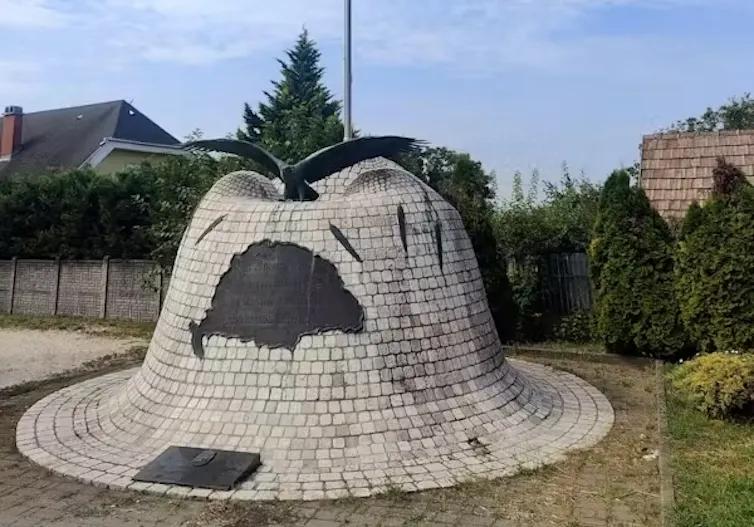
Most Trianon monuments exhibit traditional elements of Hungarian nationalism. These often include a map outline of Greater Hungary, sometimes aflame or mounted on a crucifix; the Turul, a mythical falcon carrying the sword of St. Stephen; and a half-staff flag of the Kingdom of Hungary used prior to 1920. Some take on more elaborate forms, such as burial mounds filled with silk bags of soil collected from each of the historical counties of Greater Hungary.
Brett R. Chloupek, CC BY
The persistent relevance of Trianon
A ubiquitous nationalist slogan found on Trianon memorials is “Nem, Nem, Soha!” which means “No, No, Never!” This phrase reveals that the essential meaning of such monuments is to map the historical grievances of Trianon onto modern European politics.
That’s especially the case regarding Hungary’s relationship with the Western powers that dominate the European Union. They are cast as a modern analog for the Allied powers of World War I that dictated the terms of Hungary’s surrender via the treaty and dismantled a 1,000-year-old Hungarian state.
Thus, any contentious issues between the EU and Hungary can be made to fit this template. Orbán did this extensively, including over his refusal to accept migrant quotas, which in late 2020 led the European Court of Justice to impose a 200 million euro fine plus a 1 million euro-per-day penalty.
So long as Hungary believes that the rights of Hungarian minority communities remain unsecured, the acceptance of thousands of new migrants will likewise remain a nonstarter for Magyar and his Tisza party. On this and other issues, such as Ukraine’s admittance to the EU, Magyar’s approach may be less adversarial than Orbán’s but still uncooperative going forward.
Migration may becomes less of a sticking point for Hungary vis-à-vis the EU now that the European Parliament has moved toward Orbán’s anti-immigrant politics and acquiesced to the idea of offshore migrant detention camps and increased deportations.
More broadly, many outside observers are mistaking anti-Orbán politics for anti-nationalist politics. Magyar’s participation and remarks at National Day of Unity commemorations should put to rest the idea that Hungarian nationalism rooted in memory politics is weakening. Rather, the ubiquitous neo-Trianon memorials dotting the country are a physical reminder of how central these politics have become.



