

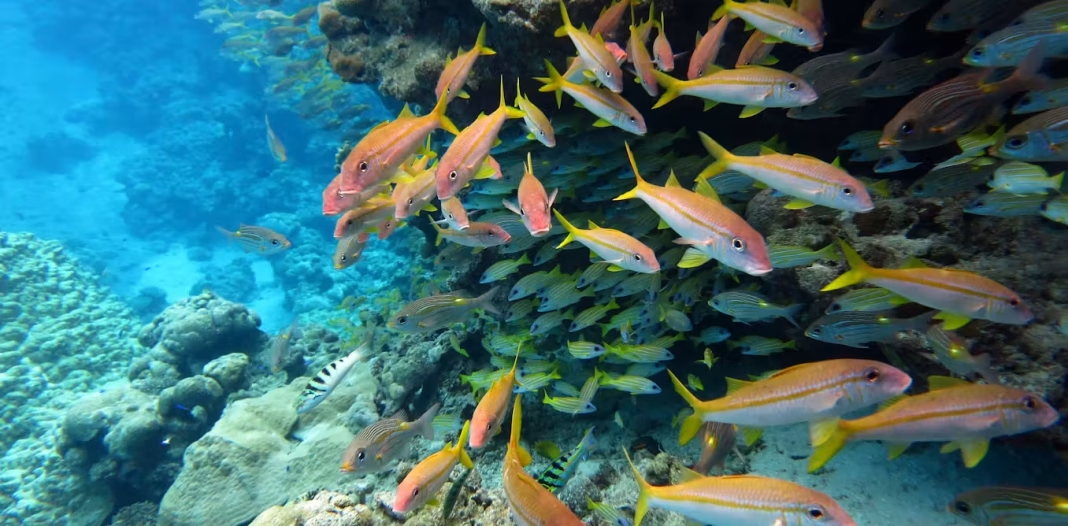

The ocean is home to some of the richest biodiversity on Earth. From coral reefs and mangrove forests to the deep sea, marine ecosystems sustain countless species, support coastal communities, regulate the climate and underpin global food security.
But these systems face growing pressure from overfishing, habitat loss, pollution and climate change.
In response, nations have adopted an ambitious global goal to conserve at least 30% of the world’s ocean by 2030 – known as 30×30. This target has expanded marine protection worldwide, particularly through marine protected areas.
But what happens after protection is announced?
Decades of experience have shown that effective marine protection requires consistent rules, regulations and oversight, along with financing and meaningful collaboration with local governments, industries and communities. Without it, these areas risk becoming paper parks: lines on a map without real-world impact, where marine life may continue to face overfishing and other threats.

Claus Giering/Unsplash, CC BY
Two new reports we led, one from Oregon State University and the other from the Smithsonian Tropical Research Institute, offer an important reality check on where marine conservation stands today and what must be done to achieve the goal of protecting 30% of the ocean.
Together they argue that the primary barrier to realizing the 30×30 ocean conservation goal is no longer ambition to protect the ocean, but effective action that can make it real.
A decade of commitments
The 30×30 goal is often promoted at global ocean meetings, including the 11th Our Ocean Conference, being held in Kenya on June 16-18, 2026.
According to the Oregon State analysis, the conservation commitments announced at past Our Ocean Conferences have helped establish more than 3.88 million square miles (10 million square kilometers) of marine protected areas, or about 2.8% of the global ocean.
In all, marine protected areas now cover nearly 10% of the global ocean. But only about 3.5% of that is fully or highly protected.
The reach of protected areas shows that voluntary pledges can translate into tangible conservation gains when progress is consistently tracked and publicly reported. However, the findings also point to a key challenge: the growing difference between the extent of protection and its effectiveness.
In other words, ocean protection cannot be judged by area alone.
The implementation gap
The Smithsonian report takes a closer look at what is needed to turn such commitments into effective conservation.
Since the Kunming-Montreal Global Biodiversity Framework was approved in 2022, with almost every country agreeing to protect at least 30% of Earth’s land and waters, marine protection has expanded considerably. However, global numbers show that at least half of existing marine protected areas remain unimplemented or inoperable, with rules and regulations not in place or even allowing destructive activities like bottom trawling.
Achieving the 30×30 goal still requires protecting an additional 20% of the ocean over the next four years. The challenge is twofold: expanding coverage, while also ensuring that the areas are actually benefiting marine life and people.

World Database on Protected Areas
Effective, long-lasting conservation depends on management plans, trained personnel, monitoring systems, enforcement capacity, sustainable financing and community participation. Without these elements, legal designation alone does not lead to biodiversity protection, thriving ecosystems and benefits to people.
Yet, across regions, the Smithsonian report found a troubling pattern: Countries’ ambition to create protected areas is outpacing their capacity to help those areas succeed.
We found two key constraints: lack of coordination around capacity development – the strengthening of skills and tools needed to effectively achieve a goal – and applying a one-size-fits-all approach to distinctly different regional contexts.

Alexis Rosenfeld/Getty Images
Many countries and communities are committed to marine protection, but they often need better continuous governance and policy, stakeholder engagement and inclusion, data and technology, socio-ecological integration, and communication for effective implementation of marine protected areas over time.
Similarly, securing funding for marine conservation remains a persistent challenge. When we spoke with groups and communities involved in marine conservation, they often cited complex application processes and funding structures that often do not match their local realities or priorities. This creates a mismatch between how conservation is funded and how it is implemented.
There are efforts to close this gap. The Bali-based Coral Triangle Center’s Coral Triangle Initiative on Coral Reefs, Fisheries and Food Security Capacity Building Roadmap works to conserve ocean areas in a region that harbors the richest marine biodiversity on the planet. Through regional training hubs, leadership programs, internships and digital platforms, it has trained over 8,200 government officials, community leaders and private-sector representatives in science-based marine conservation practices.
The Sustainable Finance Coalition, a group of nonprofits and international organizations, is using its expertise in another way: finding creative ways to secure money for projects in Africa and the South West Indian Ocean to protect key habitats on land and sea. To date, the coalition has tapped into more than US$43 million to protect nature and support the effective management of 170,500 acres (69,000 hectares).
Beyond lines on a map
The two reports found that political momentum for ocean protection is strong. Governments, Indigenous peoples, local communities, scientists and conservation organizations have rallied around the 30×30 target, creating a global movement of support.
The challenge now is delivering on this momentum.
Achieving the conservation goals behind the 30×30 plan will depend less on announcing new protected areas and more on investing in the capacity, finance, enforcement and long-term institutional support needed to help these protected areas function as planned.
As 2030 approaches, the central question is becoming sharper. It is no longer simply how much of the ocean can be protected — but whether that protection can be made real, durable and effective.